

PepeNode raised roughly $2.7 million in its presale by selling an idea that sounds almost too silly to work: a meme coin you mine without ever touching a GPU. The project built a virtual mining simulator on Ethereum, wrapped it in Pepe the Frog branding, and glued on a 70% burn mechanism to reward active players.
That mix of gamified yield, deflationary economics, and meme-driven culture is what makes PepeNode stand out from the usual presale cycle. This deep dive breaks down how the mine-to-earn loop works, what the tokenomics really imply, who is behind Neuriki Ltd, and where the risks sit before you decide if the PepeNode coin deserves a slot in a speculative memecoin basket.
How the PepeNode Virtual Mining Economy Works
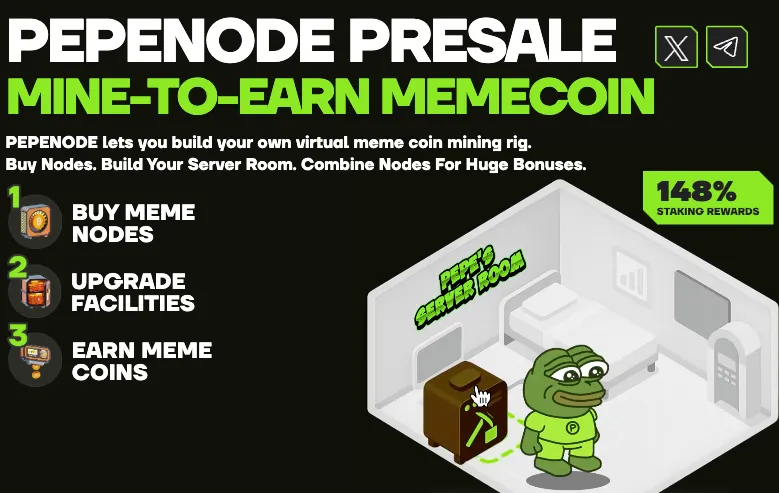
PepeNode replaces physical mining rigs with digital ones. You buy Miner Nodes using the $PEPENODE token, arrange them inside a "server room," then upgrade the setup with facility boosters and tiered node types. The more advanced your rig, the higher your hash output inside the game, and the larger your share of the reward pool. Because the simulator runs entirely in-browser, there is no hardware cost, no electricity bill, and no maintenance headache.
Rewards flow back in $PEPENODE plus partner meme coins, starting with PEPE and FARTCOIN in later phases. Two secondary incentives stack on top:
- A 2% referral kickback on everything a referred wallet mines
- A global leaderboard that pays bonus rewards to the top-performing miners each cycle
The design borrows from classic play-to-earn loops, but simplifies the onboarding. There are no NFT characters to level, no PvP timers, and no need to understand complex game theory. You buy nodes, you leave them running, you compound back into better nodes. The appeal is entirely the dopamine of a rising number tied to a frog mascot.
The 70% Burn That Sits Behind Every PepeNode Coin Upgrade
The deflationary hook matters more than the cosmetic layer. Every time a player spends PEPENODE on an upgrade or new node, 70% of those tokens are burned. The remaining 30% feeds the node-rewards pool, which pays out to active miners and stakers.
This creates two forces working in opposite directions on supply. On one side, emissions from the staking pool add circulating tokens. On the other, node spending permanently removes them. When in-game activity outpaces staking emissions, the float shrinks. When players lose interest, the burn slows and emissions dominate.
The entire model therefore hinges on keeping the game loop engaging enough that players continuously convert tokens into nodes. It is a more honest deflation mechanism than a one-time supply cut, but it only works if the simulator stays fun.
Who Is Behind PepeNode: Neuriki Ltd and the Team Question
The PepeNode token is issued by Neuriki Ltd, a company incorporated in the British Virgin Islands on July 22, 2025. Fahim Rahman is named as the managing director. The timing is notable because Neuriki was registered barely two weeks before the presale opened, which is standard for offshore token issuers but also means there is no long-running operating history behind the corporate wrapper.
The rest of the development team is only partially public. There is no linked GitHub organization, no doxxed engineering lead, and no investor page listing backers, because the raise was entirely public-sale and did not route through a VC round. For advanced readers, that is the first risk dial to adjust.
On the audit side, PepeNode commissioned two smart-contract reviews, one by Coinsult and one by SpyWolf. Both reported no critical vulnerabilities. The contract ownership has since been renounced, which removes one common rugpull vector. The audits cover the code, not the economic sustainability of the promised yields, so they should be read as necessary but not sufficient.
PepeNode Tokenomics and Supply Distribution
PepeNode launched with a fixed total supply of 210 billion tokens. The distribution splits as follows:
- 35% Protocol and Business Development
- 35% Treasury
- 15% Infrastructure and Marketing
- 7.5% Node Rewards (staking and in-game payouts)
- 7.5% Exchange Listings and Growth
Two observations matter for traders. First, 70% of the supply sits under Neuriki-controlled wallets between the protocol, treasury, and marketing buckets. Even with renounced contract ownership, the team has meaningful influence over float through how fast those allocations unlock. Second, the 7.5% node-rewards pool is the entire source of the loud APY numbers you see advertised, about 15.75 billion tokens. Once that reservoir drains, the sustaining yield depends on burn-driven scarcity rather than fresh emissions.
PepeNode Staking Rewards and the APY Reality Check
Presale marketing floated staking APYs in wildly varying ranges, from around 569% at calmer moments to peaks above 1,700% when the pool was thin. These rates are not fixed. They scale inversely with the total stake. When early participants locked small amounts, the formula spit out enormous headline numbers. As more tokens entered the pool post-TGE, those numbers compressed quickly.
A quick sanity check on the math illustrates why. If the reward pool is 15.75 billion tokens and holders collectively stake a billion PEPENODE at a 1,162% APY, the pool depletes in roughly 15 months. After that, the only reward source is the 30% non-burned portion of in-game spending. For sustainability, the game has to drive enough organic token sink volume to replenish the pool faster than staking drains it.
None of this makes PepeNode uninvestable. It does mean the token operates like a high-beta call option on sustained player engagement, not like a stable yield product.
PepeNode Timeline: Key Milestones from Incorporation to Launch
Neuriki Ltd Incorporated
Neuriki Ltd is incorporated in the British Virgin Islands, establishing the corporate issuer behind PepeNode.
PepeNode Presale Opens
The public PepeNode presale opens at roughly $0.001 per token with no private rounds.
Virtual Mining Simulator Beta
The PepeNode virtual mining simulator enters beta, letting early users test node-building mechanics.
Token Generation Event
PepeNode holds its Token Generation Event and distributes PEPENODE tokens to presale participants.
Uniswap Listing
PEPENODE lists on Uniswap and the presale closes after raising roughly $2.49M.
On-Chain Mining Transition
PepeNode shifts mining mechanics fully on-chain and introduces NFT-based mining equipment.
Multi-Token Rewards and Mobile
PepeNode rolls out multi-token meme rewards (PEPE, FARTCOIN), global leaderboards, and a mobile release.
Where PepeNode Fits in the 2026 Memecoin Landscape
The 2026 memecoin cycle is narrower than previous ones. Pure culture plays like PEPE and DOGE still dominate the top of the leaderboard, but capital has started moving toward meme-coin hybrids that offer a mechanic beyond the name. PepeNode competes for that hybrid capital alongside Pepeto, which pushes a cross-chain bridge story, and newer virtual-mining projects like DeepSnitch AI that add an AI narrative.
Compared to older play-to-earn miners such as Rollercoin, PepeNode trades depth for accessibility. Rollercoin has five years of player history and an established reward economy. PepeNode has fresher tokenomics, the deflationary burn, and a Pepe-native audience that responds to meme triggers faster than traditional gamers. Its runway depends on whether the team can ship on-chain mining and meme-reward integrations on schedule through Q2 and Q3 2026.
PepeNode Presale Takeaways for Advanced Traders
A few signals to watch if you hold PEPENODE or are thinking about it post-TGE:
- Daily active node spend, because that drives the burn and is the honest health metric
- Staking pool size versus the reward reservoir, to track runway before rewards compress
- Tier-1 centralized exchange listing announcements, which the 7.5% listings allocation is earmarked to fund
- Treasury wallet movements, given 35% of supply sits there
- Phase 3 and Phase 4 product shipping against the public roadmap
The project has the unusual profile of being deflationary by design but still front-loaded on emissions, so the early months post-launch are the window where the model either proves itself or exposes the gap between marketing APY and on-chain reality.
Final Read on the PepeNode Coin
PepeNode is a meme coin with a structured game loop, a real burn mechanism, and a thin but present layer of audit coverage. It is not a stealth Ponzi, but it is also not a conservative hold. The token works best as a speculative position sized to what a trader can lose entirely, held alongside metrics that track in-game engagement rather than price alone. The mine-to-earn concept is fresh enough to attract attention through 2026, and the 70% burn gives it a mechanical reason to outperform pure-culture memes if the simulator becomes habit-forming. The weak points are standard memecoin territory: offshore issuer, partially public team, aggressive headline yields, and a heavy dependence on narrative momentum.
Advanced readers should treat PEPENODE as a trade on continued memecoin rotation plus execution on the virtual-mining product, not as a diversified crypto allocation.
