
KEY POINTS
- STRC is Strategy's perpetual preferred stock trading at $100 par value on Nasdaq, paying an 11.5% annual dividend in monthly cash installments.
- The STRC dividend has increased every month since launching at 9% in July 2025, reaching 11.5% by March 2026 before holding steady in April.
- Strategy holds over 712,000 Bitcoin funded by $8.2 billion in convertible debt, making the MicroStrategy Bitcoin risk picture the single most important variable for any STRC investor.
If you are a yield-hungry investor scanning for income in a world where savings accounts pay next to nothing, a stock paying 11.5% monthly cash dividends is going to catch your eye. That is exactly what Strategy's STRC preferred stock is offering right now.
STRC is not a standard dividend stock, and the company behind it is not a standard company. Strategy, formerly known as MicroStrategy, has essentially reinvented itself as the world's largest corporate Bitcoin holder, and STRC is one of the instruments it uses to fund those purchases. Understanding what that means for your money is non-negotiable before buying a single share.
What is STRC and how does it work?
STRC, officially called Strategy's Variable Rate Series A Perpetual Stretch Preferred Stock, trades on Nasdaq under the ticker STRC. It has a par value of $100 per share and pays dividends monthly in cash. The current STRC dividend rate is 11.5% annually, which works out to approximately $0.96 per share every month.
The "variable rate" part is the most unusual feature. Strategy adjusts the STRC dividend each month specifically to keep the share price anchored close to $100. If the price drifts above par, the company can trim the yield to cool demand. If it falls below, they raise it to attract buyers. This mechanism has worked remarkably well in practice. Since its 2025 launch, STRC's all-time high was $100.42 and its all-time low was $88, reached in its early weeks before the mechanism stabilised.
On April 9, 2026, STRC recorded one of its highest single-day trading volumes since launch at approximately $333 million in volume, while moving just one penny in price. Strategy chairman Michael Saylor noted publicly that this illustrated exactly what the instrument was designed to do: near-zero volatility with high liquidity.
How often does STRC pay dividends?
STRC pays dividends every month. This is one of the clearest structural differences between STRC and most preferred stocks, which typically pay quarterly. The next ex-dividend date is April 15, 2026, with payment on April 30. Monthly payment frequency is deliberate. Strategy positions STRC as a short-duration, high-yield savings alternative, and monthly cash distributions support that framing.
The dividend rate history since launch tells an important story about how the instrument has evolved:
| Month | STRC Dividend Rate |
| July 2025 (Launch) | 9.00% |
| August 2025 | 9.25% |
| October 2025 | 9.75% |
| December 2025 | 10.75% |
| January 2026 | 11.00% |
| February 2026 | 11.25% |
| March 2026 | 11.50% |
| April 2026 | 11.50% (held) |
Seven consecutive increases followed by the first hold in April 2026, when STRC's monthly VWAP reached $99.95, close enough to par that a raise was not needed.
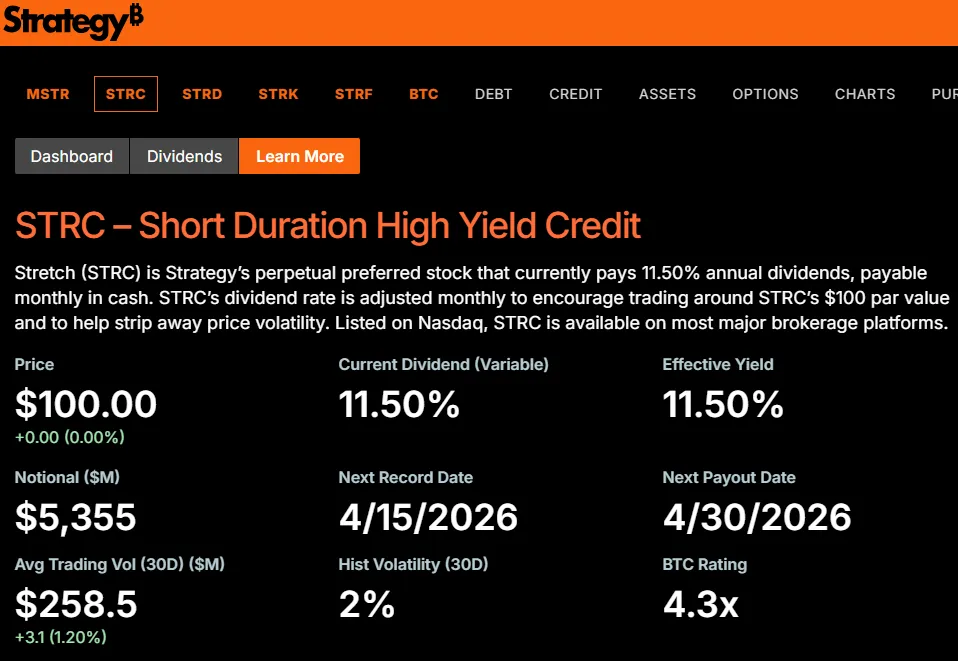
Image by Strategy
The MicroStrategy Bitcoin risk picture in 2026
Here is the part of the STRC story that no income investor can afford to skip.
Strategy holds over 712,000 Bitcoin, making it the world's largest corporate BTC holder by a wide margin. Virtually the entire company's valuation, and much of its ability to service its financial obligations, is tied to Bitcoin's price. The company funded those purchases aggressively through $8.2 billion in convertible notes and multiple series of preferred stock including STRC.
The MicroStrategy Bitcoin risk in 2026 centers on several specific pressure points. The largest is $5 billion in convertible bonds maturing in 2028 that are currently out of the money, meaning the conversion price is higher than the current stock price. If Bitcoin falls sharply before those bonds come due, Strategy could face a brutal choice between selling Bitcoin at depressed prices or restructuring its debt. S&P analysts have specifically flagged this as the most significant near-term risk.
Strategy's cash reserve of approximately $2.25 billion provides roughly 2.5 years of coverage for its dividend obligations across all preferred shares. The total annual dividend obligation across its preferred share series sits near $800 million. STRC itself had grown to an aggregate stated value of approximately $3.4 billion by early 2026.
Crucially, STRC preferred shares are not collateralized by Strategy's Bitcoin holdings. They only have a preferred claim on the residual assets of the company in a liquidation scenario. That is an important distinction from secured debt.
STRC vs MSTR: Two very different ways to access the same company
This is where the comparison matters most for investors deciding how to approach Strategy.

MSTR common stock has fallen approximately 80% from its November 2024 peak, tracking Bitcoin's decline from around $126,000 down to current levels, and then amplifying that move due to leverage. STRC has traded in a roughly $88 to $100.42 range for the same period, demonstrating significantly lower volatility.
The trade-off is straightforward: MSTR gives you all the Bitcoin upside and all the downside. STRC gives you monthly income with price stability, but no participation in a Bitcoin bull run.
Is STRC a good investment?
Whether STRC is a good investment depends almost entirely on how you weigh two things: how attractive 11.5% monthly cash income is, and how comfortable you are with the underlying MicroStrategy Bitcoin risk.
The case for STRC is genuine. The yield is exceptional compared to most fixed income alternatives. The monthly payment frequency is investor-friendly. The price stability mechanism has worked as designed since launch. Strategy's $2.25 billion cash reserve provides a meaningful multi-year buffer for dividend payments even if Bitcoin stays depressed. And institutional buyers like Strive have already committed $50 million to STRC as part of their own treasury strategy, which is a credible signal of confidence in the instrument's structure.
The case against is equally real. STRC is perpetual, meaning Strategy has no obligation to ever redeem it. If Bitcoin falls sharply and Strategy's financial position deteriorates, preferred dividends can be suspended. While STRC holds a preferred position over common equity, it sits behind secured creditors and has no direct claim on the Bitcoin stack. The $800 million annual dividend obligation across all preferred series is a significant recurring cost that Strategy funds through ongoing capital raises, not operating revenue.
The honest framing is that STRC is not a bond. It is a high-yield, Bitcoin-adjacent income instrument issued by a company that is entirely dependent on Bitcoin's price for its long-term solvency. For investors who understand that, want monthly income, and can tolerate the tail risk, the 11.5% yield is a meaningful proposition. For investors looking for truly safe, predictable income, the underlying risk profile of the issuer matters too much to ignore.
As always, do your own research and never invest more than you can afford to lose.
STRC Stock: From Launch to $3.4 Billion in Nine Months Abstract
STRC launches on Nasdaq at 9% dividend
Strategy lists its Variable Rate Series A Perpetual Stretch Preferred Stock on Nasdaq at $100 par value with a 9% opening dividend. The stock briefly touches an all-time low of $88 before the monthly rate adjustment mechanism begins stabilising the price near par.
Monthly dividend payments begin
Strategy completes its first full monthly payout cycle. STRC begins trading consistently near its $100 par value as the yield adjustment mechanism builds investor confidence. At-the-market issuance accelerates as the price anchors.
STRC aggregate value surpasses $1 billion
Continued at-the-market share issuance pushes STRC's aggregate stated value past the $1 billion mark. The dividend is raised to 9.75%, marking the third consecutive monthly increase since launch.
Strategy reports $17.44 billion in Bitcoin losses
Bitcoin falls 25% in Q4 2025, triggering a reported $17.44 billion unrealized loss under new FASB fair-value accounting rules. STRC holds near $100 throughout the volatility, demonstrating the stability the instrument was designed to provide. Dividend raised to 10.75%.
$2.25 billion USD Reserve established
Strategy announces a $2.25 billion cash reserve providing over 2.5 years of dividend coverage across all preferred series. STRC aggregate stated value reaches $3.4 billion. Dividend raised to 11.25% for the sixth consecutive monthly increase.
Seventh consecutive dividend increase to 11.5%
STRC reaches its current dividend rate of 11.5% as Strategy raises the payout by a further 25 basis points. MSTR common stock records its eighth consecutive monthly decline during the same period, highlighting the stark contrast in stability between the two instruments.
First dividend hold and record liquidity
STRC holds its dividend flat at 11.5% for the first time since launch, after VWAP reaches $99.95. Strive commits $50 million to STRC. The stock records $333 million in single-day volume with just one penny of price movement, confirming the mechanism is working as designed.
