Migrant workers send close to $900 billion home every year, and a significant portion of it vanishes in fees before it reaches the people who need it most. Western Union charges up to 10% per transfer. Banks pile on hidden exchange rate margins. Transfers that should take seconds can take five business days. For someone sending $200 back to their family, losing $20 to a middleman is not a rounding error , that is a week of groceries.
Blockchain has been promising to fix this for over a decade. Most projects failed. Remittix is the latest attempt, and its approach is different enough to be worth examining seriously. The protocol lets users send cryptocurrency while the recipient receives local fiat currency directly in their bank account , no wallet, no exchange, no crypto knowledge required on the receiving end. RTX is the token that makes it run. Here is what the project actually does, what the token is worth tracking, and what risks investors and users need to understand before getting involved.
What Is Remittix and What Problem Does It Solve?
Remittix is a cross-border payment protocol built on blockchain. Its core mechanism is straightforward: a sender initiates a transfer using RTX or another supported crypto asset, and Remittix converts and routes that value so the recipient receives local fiat currency directly into their bank account , anywhere in the world.
This solves a problem that has derailed most crypto remittance projects before it: the last-mile delivery problem. Moving value across borders using Bitcoin or Ethereum is already fast and cheap. The hard part is converting that crypto into spendable cash for someone who does not have a crypto wallet, does not understand exchanges, and just needs money in their account. Remittix handles that conversion and delivery layer, which means the recipient experience looks identical to receiving a standard wire transfer, while the sender benefits from crypto-speed settlement and lower fees.
The RTX token is the native currency of the ecosystem. It is used to pay transaction fees on the network, and holders can stake it to earn a share of those fees as passive income.
How the Remittix Protocol Works
The payment flow is designed to minimize friction on both ends:
- The sender selects a destination country and the recipient's bank account details
- They fund the transfer using RTX or other supported crypto (ETH, BNB, USDT)
- Remittix converts the crypto at the current market rate, applies its protocol fee, and routes the fiat equivalent
- The recipient sees local currency arrive in their bank account , no action required on their end
Remittix claims support for over 40 fiat currencies, covering the major remittance corridors across Latin America, Southeast Asia, Africa, and Europe. The protocol targets transaction fees well below the global average of 6.2% cited by the World Bank , the project's stated goal is sub-3% fees across most corridors.
Settlement speed is the other key differentiator. Traditional international wire transfers clear in two to five business days. Remittix targets completion in minutes to hours, with the final leg of delivery dependent on the destination banking network's own settlement infrastructure.
Every transaction is recorded on-chain, which creates an auditable record that legacy services fundamentally cannot offer. For compliance-sensitive corridors and users who care about proof of payment, that transparency has real value.
RTX Tokenomics: Supply, Staking, and the Burn Mechanism
RTX entered the market through a staged public presale, with pricing structured to increase as each stage sells out. This is a standard mechanism designed to reward early participants while funding protocol development.
Three tokenomic features define RTX's value structure:
- Fee utility: Every transfer processed through the Remittix protocol requires RTX to pay the network fee. This creates baseline demand tied directly to transaction volume rather than speculation alone.
- Staking rewards: RTX holders can stake their tokens to earn a share of protocol fees. As transaction volume grows, staking yields grow proportionally , tying passive income directly to adoption.
- Buyback-and-burn: A defined percentage of all protocol fees is used to purchase RTX on the open market and permanently remove it from circulation. This deflationary mechanism means that higher network usage reduces circulating supply, which creates upward price pressure if demand holds.
The buyback-and-burn model is one of the more credible tokenomic structures in the presale space because it connects the token's scarcity to real economic activity. It does not guarantee price appreciation, but it does mean RTX is not purely a speculation vehicle with no underlying demand driver.
Who Is Behind Remittix — and How Much Has It Raised?
Remittix has raised over $30 million from more than 40,000 holders through its public presale, making it one of the larger retail-funded presales of the cycle. There is no venture capital backing on record. That removes institutional due diligence from the equation, but it also means no VC unlock schedules will create sell pressure after listing.
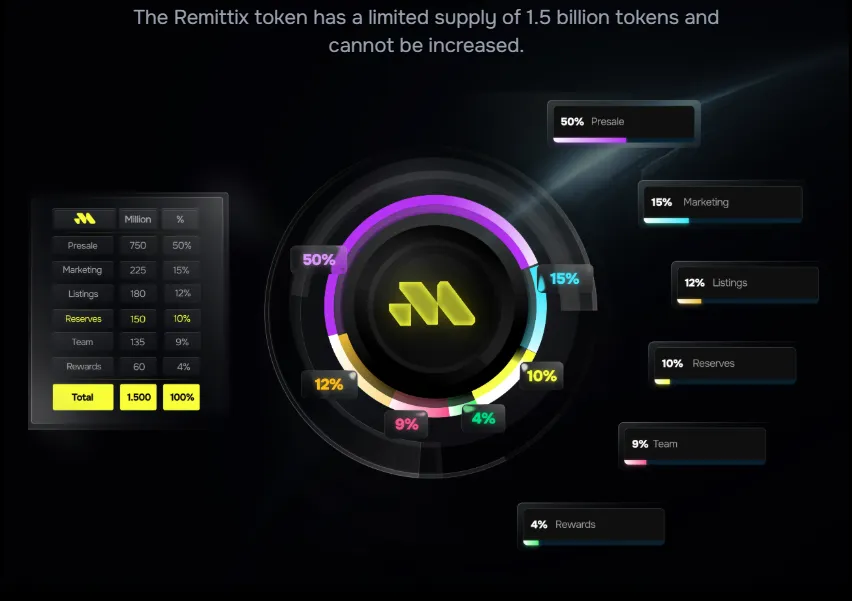
The founding team is anonymous. Four core members underwent private KYC verification by CertiK but are not publicly named. The corporate entity, Remittix Labs Limited, is registered in the Marshall Islands. Anonymous teams are common in crypto, but the absence of named founders shifts the trust burden entirely onto the project's audits, code, and on-chain execution rather than personal reputation.
Remittix vs. The Competition

Is Remittix Legit? Audits, Transparency, and Real Risks
"Is Remittix legit" ranks among the most searched questions about the project, and it deserves a direct answer.
Several factors support the legitimacy of the project. Remittix has had its smart contracts audited by CertiK, one of the most recognized names in blockchain security. The audit reports are publicly available, and the presale contract passed without critical findings. Four core team members also completed private KYC verification through CertiK, meaning their identities are on file with the auditor even though they are not publicly disclosed. The presale mechanics, token allocation, and vesting schedules are documented publicly, which reduces the risk of a simple rug pull. Unlike many speculative tokens, RTX has a defined use case tied to real transaction volume: fees paid in RTX for every transfer processed.
That said, legitimate concerns exist. Many presale projects have limited public-facing team transparency. If the founding team is not fully doxxed, that increases counterparty risk. The remittance market is also heavily regulated. Obtaining money transmitter licenses across jurisdictions is expensive and time-consuming. The biggest question for any remittance protocol is regulatory compliance, not the technology. At presale stage, there is no live product generating revenue. All value is based on future expectations.
Legitimate does not mean low-risk. Remittix checks enough boxes to be taken seriously, but it remains an early-stage project in a competitive, regulated market.
When Will Remittix Launch?
Remittix launched its payment ecosystem globally on February 9, 2026, following the completion of its presale. The platform supports 60+ countries and over 120 fiat currencies at launch. A Web3 wallet — supporting Bitcoin, Ethereum, Solana, and TRON — entered beta testing ahead of the full launch, giving early holders a preview of the core product.
RTX is now listed on LBank, one of the exchanges announced during the presale raise. The listing timeline followed the roadmap closely, which is a positive signal for a presale project, where post-raise delays are common. The real test from this point is adoption: whether payment volume builds, whether the fiat payout rails work at scale, and whether the protocol can hold up under real-world regulatory scrutiny in target markets.
What Remittix Still Has to Prove
The remittance market has attracted blockchain projects for a decade. Most have failed to achieve meaningful adoption, not because the technology does not work, but because distribution, regulation, and user behavior are harder problems than the blockchain architecture.
Remittix has a cleaner user story than most. The send-crypto-receive-cash model is genuinely simple and addresses a real pain point. But simplicity at the UX layer does not solve the complexity underneath: banking partnerships, compliance frameworks, and the trust deficit that crypto still carries in many markets.
The projects that succeed in remittances will be the ones that can bridge compliance and crypto without sacrificing either. Whether Remittix can thread that needle depends heavily on its founding team's execution capability and the regulatory traction it can build in its target corridors.
For investors, the calculus is straightforward: genuine user demand for cross-border payment alternatives is real and growing. The token's deflationary mechanics and clear use case are positives. The presale stage and regulatory uncertainty are the primary risks.
