

1. Copy Trading Master’s Introduction
- User Nickname: LBA4D56971
- Trader's Profile: https://www.lbank.com/copy-trading/lead-trader/LBA4D56971
- Trading Style: Swing Trading
2. Trade Operation Recap
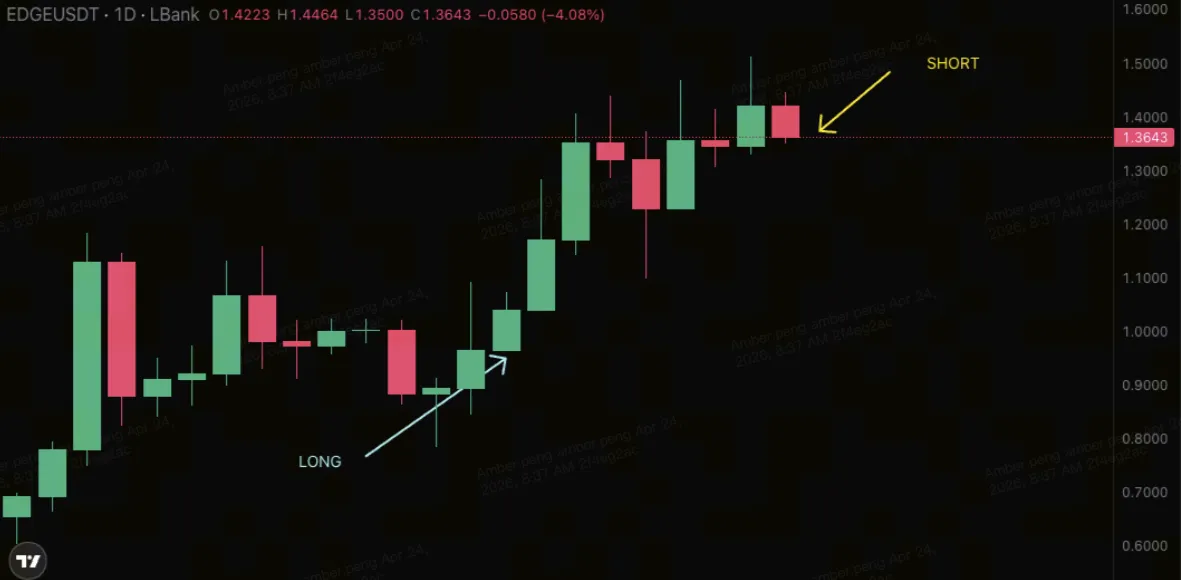
Opened a long position on EDGE with 5x cross margin leverage. Entry price: 1.0060 USDT; exit price: 1.36717 USDT; single trade ROI: +179.47%. As shown below.

3. Trade Review
3.1 Market Background
On April 7, less than 12 hours after U.S. President Trump threatened to wipe out Iran’s entire civilization, U.S.–Iran tensions dramatically reversed. Trump announced that he would accept a two-week ceasefire proposal mediated by Pakistan, and both Israel and Iran also accepted the proposal. Iran also stated that U.S.–Iran talks would begin on April 10 in Islamabad, the capital of Pakistan.
On April 12, the 21-hour marathon talks between the U.S. and Iran in Islamabad ended without results. Both sides refused to compromise on core issues such as the nuclear issue and control of the strait. Trump then threatened to impose a naval blockade on the Strait of Hormuz.
On April 14, Reuters, citing sources, reported that U.S. and Iranian delegations would hold talks later that week in Islamabad, Pakistan. An official from the Iranian embassy in Pakistan said that the next round of talks between the U.S. and Iran might take place later that week or early the following week.
On April 18, a ceasefire between Israel and Lebanon took effect, and Iran announced the reopening of the Strait of Hormuz, making the Islamabad talks seem imminent. However, Trump subsequently announced that the U.S. maritime blockade would not be lifted and ordered inspections of vessels heading to Iran. Iran then announced the re-closure of the strait and firmly rejected a second round of talks.
On April 22, U.S. President Trump clearly stated that there is currently “no timetable” for ending the conflict with Iran and that there is no urgency. This further strengthened market expectations of a prolonged conflict. According to media reports, after Iran refused at the last minute to send a delegation, U.S. Vice President JD Vance’s planned trip to Islamabad to restart talks was indefinitely postponed, completely breaking market expectations for a near-term agreement.
On April 23, Iran’s Deputy Speaker of Parliament stated that the first batch of transit fee revenue from the Strait of Hormuz had been transferred to the central bank account. On the same day, Iran’s Mahan Air announced that it would gradually resume passenger flights between Iran and China starting from the 26th; Qatar Airways also announced that it would resume flight operations between Doha and Dubai and other cities.
3.2 Trade Analysis
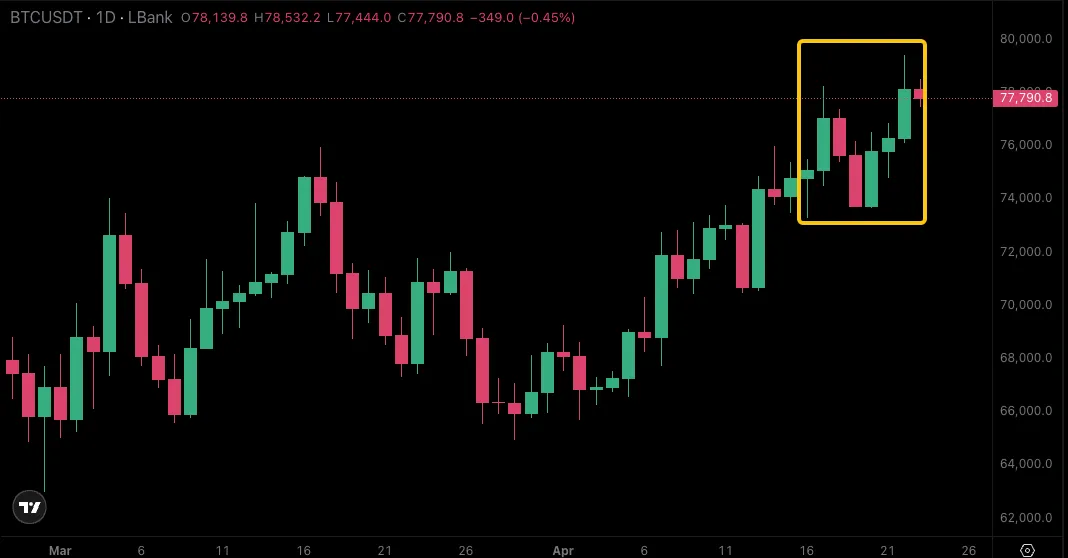
From March 1 to April 23, BTC price chart: rose in a trend from $64,000 to $79,500, then peaked at $80,000 and pulled back. Trading context as shown below:
On February 28, the United States and Israel launched a joint military strike on Iran, triggering a sharp escalation in regional tensions. On the same day, gold futures surged, while the cryptocurrency market dropped sharply.
On March 21, U.S. President Trump posted on the social media platform “Truth Social” that if Iran failed to fully reopen the Strait of Hormuz within 48 hours without any conditions, the United States would strike and completely destroy various power plants within Iran, with the largest facility to be targeted first (Iran later stated it would respond strongly, Trump TACO).
On April 7, less than 12 hours after U.S. President Trump threatened to wipe out Iran’s entire civilization, U.S.–Iran tensions dramatically reversed. Trump announced that he would accept a two-week ceasefire proposal mediated by Pakistan, and both Israel and Iran also accepted the proposal. Iran also stated that U.S.–Iran talks would begin on April 10 in Islamabad, the capital of Pakistan.
On April 14, Reuters, citing sources, reported that U.S. and Iranian delegations would hold talks later that week in Islamabad, Pakistan. An official from the Iranian embassy in Pakistan said that the next round of talks between the U.S. and Iran might take place later that week or early the following week. In the first round of talks, the two sides did not reach an agreement, but military conflict did not continue to escalate.
On the 4-hour chart, EDGE has been rising since March, forming a relative top around $1.20. It then entered a triangular consolidation phase and, after breaking below the support line, fell from around $0.95 to about $0.75, stabilizing near $0.80 before reclaiming $0.95. After EDGE rose again to $1.00, a long position was opened, as shown below:
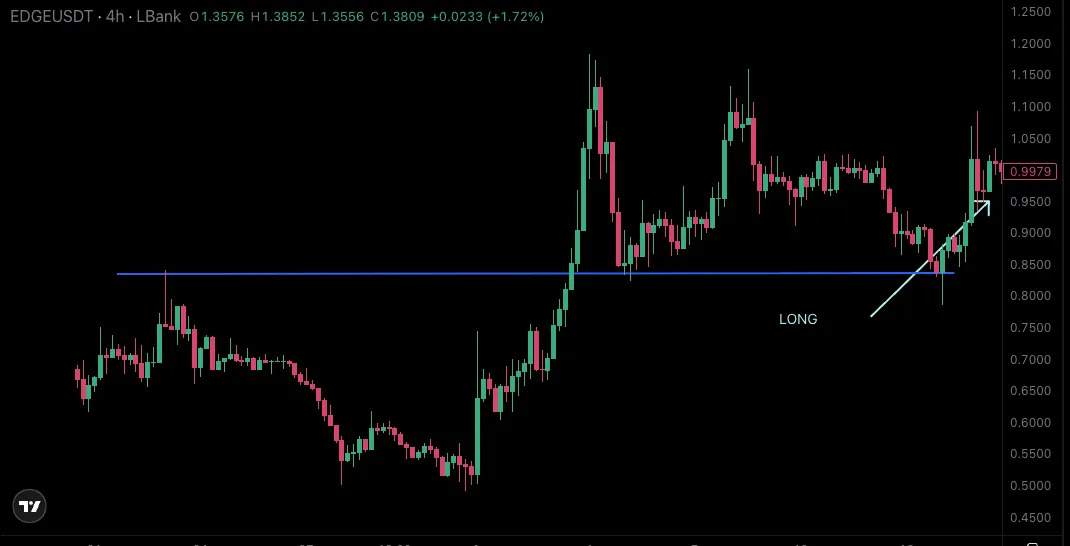
After that, EDGE surged rapidly, and the position was held.
On April 18, a ceasefire between Israel and Lebanon took effect, and Iran announced the reopening of the Strait of Hormuz, making the Islamabad talks seem imminent. However, Trump subsequently announced that the U.S. maritime blockade would not be lifted and ordered inspections of vessels heading to Iran. Iran then announced the re-closure of the strait and firmly rejected a second round of talks. The cryptocurrency market dropped accordingly that day and continued to decline for the next two days.
On April 20, the U.S. side again TACO, and the U.S.–Iran military conflict remained frozen.
On April 22, U.S. President Trump clearly stated that there is currently “no timetable” for ending the conflict with Iran and that there is no urgency. This further strengthened market expectations of a prolonged conflict. According to media reports, after Iran refused at the last minute to send a delegation, U.S. Vice President JD Vance’s planned trip to Islamabad to restart talks was indefinitely postponed, completely breaking market expectations for a near-term agreement.
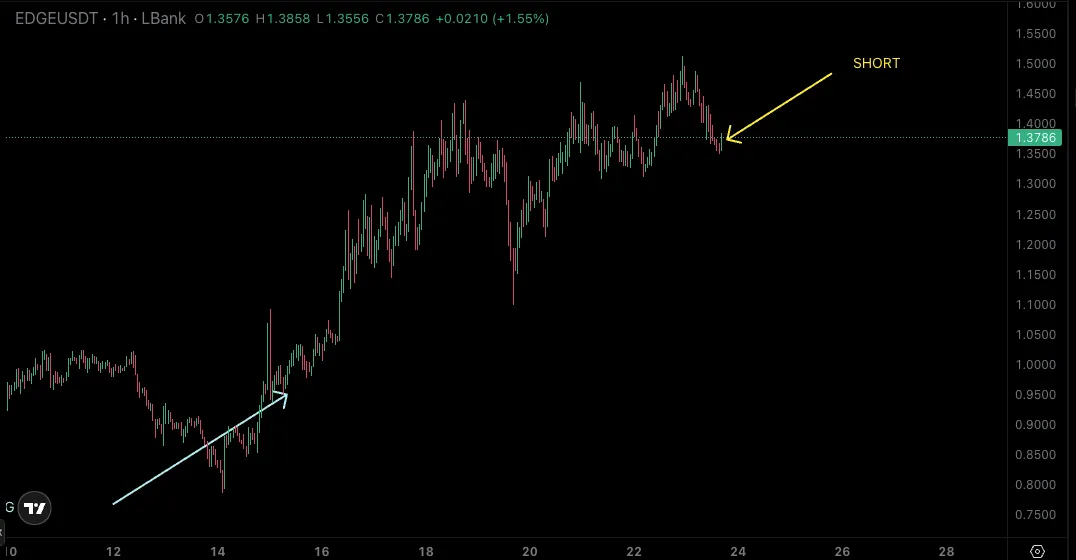
The second round of talks between the U.S. and Iran did not take place as scheduled, and before the key moment arrived, the U.S. side again TACO. However, after rising to around $1.50, EDGE began to weaken. When the price fell below $1.40, the position was closed, as shown below:
3.3 Winning Strategies Summary
Post-Trade Review: How to Handle Breaking News in Trend Trading?
In trend trading, one core principle must be clear: price comes before news. Breaking news itself does not determine direction; what truly drives the market is the gap in expectations and the price reaction. Bullish news without a price increase often signals a top, while bearish news without a decline may indicate a bottom. Therefore, the key to deciding whether to act is not the content of the news, but whether the price structure has been broken, such as changes in highs and lows, trendlines, or abnormal shifts in trading volume.
If breaking news is to be categorized, only a small portion (such as sudden policy changes or black swan events) will alter the long-term trend and require immediate reassessment of positions, including stopping out or even reversing. Some news may reinforce the existing trend and can be used as opportunities to add positions in the trend direction, but only after a pullback confirms it. The majority of news, however, is merely short-term noise and does not affect the medium-term trend. In such cases, the optimal approach is often to ignore it and avoid trading based on emotions.
At the execution level, a “counter-emotion mechanism” should be established. Set rules in advance—for example, observe first during large volatility, do not adjust positions unless the structure is broken, and only act after a confirmed pullback. Use “whether the trend structure is broken” as the sole decision criterion. At the same time, combine this with your existing models of sentiment, open interest (OI), and funding rates. Only participate when news triggers a resonance among price, sentiment, and capital; otherwise, treat it as noise. This can significantly reduce the risk of being shaken out by breaking news.
During this EDGE trade, there were reports that the second round of U.S.–Iran talks would not take place. U.S. representatives arrived in Pakistan, but the talks ultimately did not happen. However, the U.S. also did not escalate military action. Oil prices experienced a sharp drop and then rebounded. If one focused solely on macro news, it would have been difficult to hold the EDGE position until it made new highs again. On one hand, BTC had already begun to correct before the announcement that talks would not proceed; the news only accelerated the decline, and expectations of military conflict had largely been priced in by the market. On the other hand, U.S. stock indices rebounded from their lows and reached new all-time highs. Although Bitcoin’s gains were also in sync during the same period, considering Bitcoin’s high beta nature, with U.S. equities at elevated levels, BTC still had room to rise.
Understand it and hold it, leave the rest to the market and probability.
Want to trade like the pros? Start your journey with LBank Copy Trading today and follow top-performing traders automatically.
Note: Personal opinion, for reference only. Opportunities and risks abound, always do your research before investing.
