
Updated in April 2026
Key Takeaways
- Copy trading lets you automatically mirror the trades of an experienced trader in real time, with no manual entries and no constant chart-watching.
- On LBank, it is free to join; you only pay a 10% to 20% profit share to the lead trader when they make you money.
- Top LBank lead traders currently post 30-day ROI over 200%, but high returns come with real risk, and past performance never guarantees future results.
- This guide covers how copy trading works, the risks, how to copy a trader on LBank in six steps, and how to become a lead trader yourself.
What Is Copy Trading?
Copy trading is an investment strategy where you automatically replicate the trades of an experienced trader in real time. When the trader you follow (usually called a "lead trader" or "master trader") opens a position, the same position opens in your account, sized proportionally to the capital you've allocated. When they close it, yours closes too.
The concept started in forex in the early 2000s and has since spread across stocks, futures, and, most actively today, cryptocurrency. It sits at the intersection of automated investing and social investing: you get the hands-off execution of a bot, but your strategy is set by a real human with a public track record.
Copy trading appeals to three groups in particular.
- Beginners use it to get market exposure without having to master technical analysis.
- Busy traders rely on it because they don't have time to monitor charts all day.
- Even experienced traders copy to diversify across strategies they don't personally specialize in.
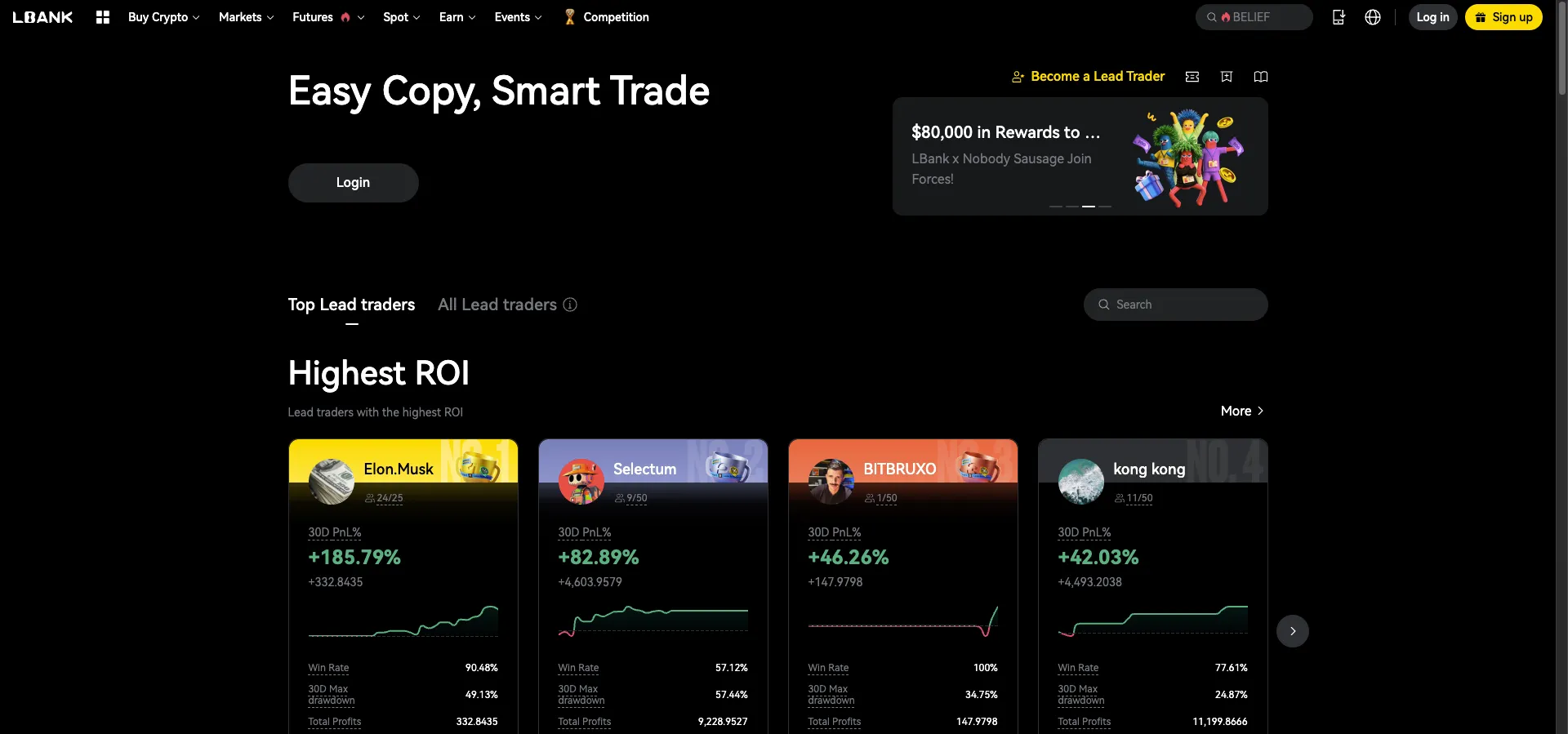
Copy Trading on LBank
How Does Copy Trading Work?
The mechanics are similar across most crypto platforms, including LBank. First, you choose an exchange or broker that offers copy trading as a built-in feature. You then browse the leaderboard, a ranked list of lead traders with performance stats like 30-day ROI, win rate, maximum drawdown, and number of active copiers. Once you find a trader whose style and risk profile match yours, you allocate your funds and decide how much capital to dedicate to that trader.
Most platforms offer two allocation modes: a fixed amount per trade (for example, every copy trade uses exactly $50 of your funds) or a fixed ratio (your position is always 10% of the lead trader's position). After allocation, the platform mirrors the trader's orders into your account automatically. You can set your own stop-loss, adjust allocation, or stop copying at any time.
Your funds never leave your own account. You're not investing in the trader. You're giving the platform permission to execute orders that match theirs, using your capital, in your wallet.
Why Traders Use Copy Trading
The biggest draw is a low barrier to entry. You can start with a small amount and learn by watching how a professional manages entries, exits, position sizing, and stop-loss placement. Time efficiency is close behind. Crypto markets run 24/7, and copy trading removes the need to sit in front of charts, because orders are mirrored automatically the moment the lead trader executes.
Diversification is another underappreciated benefit. You can copy multiple traders at once, for example one focused on Bitcoin swing trades and another running altcoin momentum strategies, which spreads capital across uncorrelated styles and reduces concentration risk. Unlike traditional asset managers, lead traders on public platforms expose every trade, win rate, and drawdown, so you're choosing from audited history rather than marketing decks.
Finally, copy trading tends to remove emotional trading. Many retail losses come from panic selling or FOMO buying. Following a systematic strategy enforces discipline that most self-directed traders struggle to maintain.
The Risks of Copy Trading
Copy trading is not passive income. Every risk the lead trader takes becomes your risk, and there are five worth knowing before you allocate a single dollar.
The most obvious is market risk. If the crypto market crashes, your copied positions crash with it, and a trader's historical ROI doesn't insulate you from a broad drawdown. Closely related is lead-trader performance risk: even a 90%-win-rate trader has cold streaks, and past performance is not indicative of future results. Leverage amplifies both directions, and because many crypto lead traders use leverage, your copied position is leveraged too.
On your side, over-concentration is the single biggest mistake new copiers make. Allocating most of your capital to a single lead trader turns a strategy into a bet. The last category is platform and security risk: not all copy trading venues are equal, so stick to licensed exchanges with strong KYC, audited security, and clear fund-segregation policies.
Risk is manageable with position sizing, diversification, and strict stop-loss limits, but it is never zero. Never copy trade with capital you can't afford to lose.
How Copy Trading Works on LBank
LBank's copy trading service is built around a public leaderboard and a structured lead-trader tier system.
The LBank Leaderboard
The leaderboard at LBank Copy Trading ranks lead traders across several views, including Highest ROI, Highest Profit, Lowest Drawdown, Highest Copiers' Profit, Star Traders, and Today's Top Performer. Each trader card shows 30-day ROI, win rate, 30-day max drawdown, AUM, total profits, and how many copier slots are still open.
You can filter by strategy type, minimum track record, and risk profile, then click into any trader's profile to see their full trade-by-trade history before you commit.
Fees and Profit Sharing
LBank does not charge a separate platform fee for copy trading. You only pay the lead trader's profit share, which is set by their tier:
| Tier | Lead Trader Equity (USDT) | Profit Share | Max Followers |
| Bronze | 50 to 499 | 10% | 50 |
| Silver | 500 to 1,999 | 12% | 100 |
| Gold | 2,000 to 4,999 | 14% | 250 |
| Diamond | 5,000 to 9,999 | 16% | 750 |
| King | 10,000+ | 20% | 1,000 |
Source: Trader Tier System, LBank Copy Trading
The profit share is taken from net profits only. If you lose money, you pay nothing. As an example, if you copy a Gold-tier trader and net $500 in profit over a settlement period, you keep $430 and the trader receives $70 (14%).
Risk Controls
LBank caps how many copiers a lead trader can accept, starting at 50 at Bronze and rising to 1,000 at King tier. This prevents a single trader from accumulating unmanageable AUM and helps keep execution slippage in check. When a trader's slots fill up, new copiers can't join until someone leaves, so the leaderboard's copier/capacity ratio is also a demand signal.
How to Start Copy Trading on LBank (Step-by-Step)
Step 1. Create an LBank account
Sign up or log in at lbank.com and complete KYC verification.
Step 2. Deposit USDT
Copy trading on LBank is settled in USDT, so fund your account before you start browsing.
Step 3. Open the copy trading page
Go to LBank Copy Trading and you'll land on the leaderboard, or open the full list under "All Lead Trader" tab.
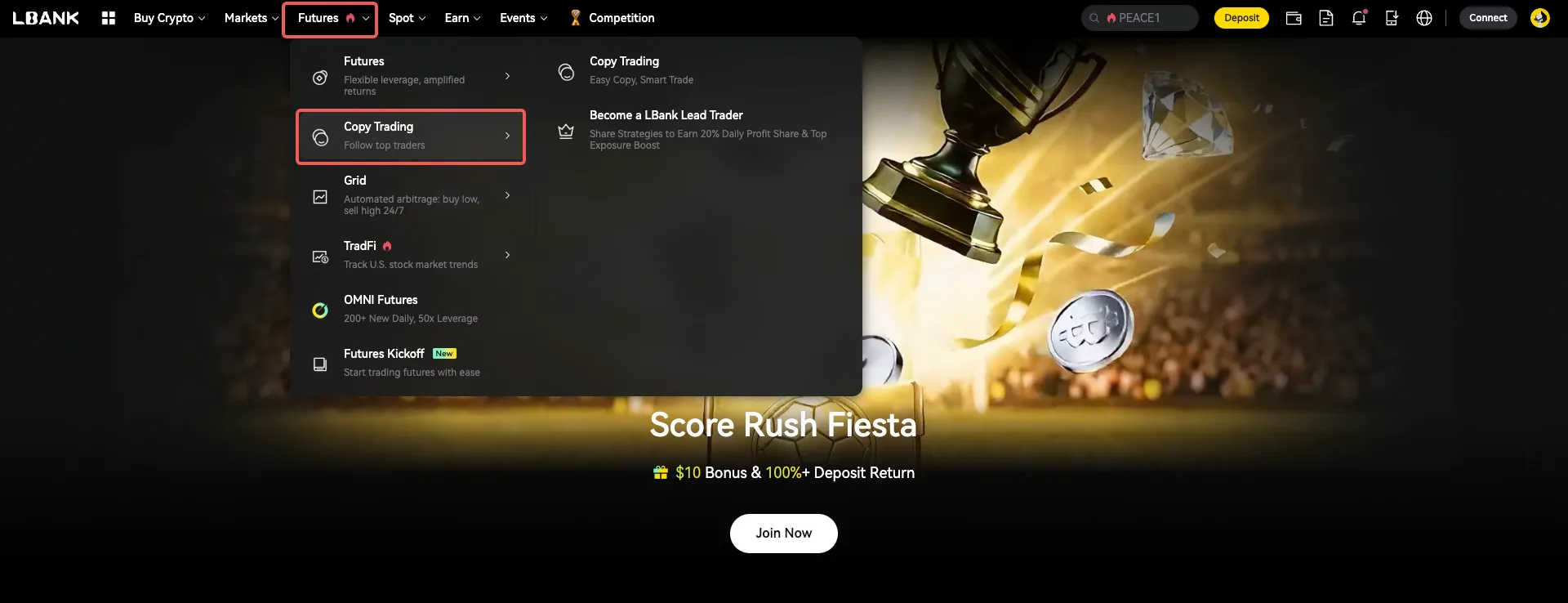
LBank Copy Trading Navigation
Step 4. Filter and pick a lead trader
Use the sort tabs (Highest ROI, Lowest Drawdown, Star Traders) to narrow the list, then click into each trader's profile to check win rate, max drawdown, trade count, and strategy description. Don't pick based on ROI alone. A trader with a 300% return and 80% drawdown is not a safe copy.
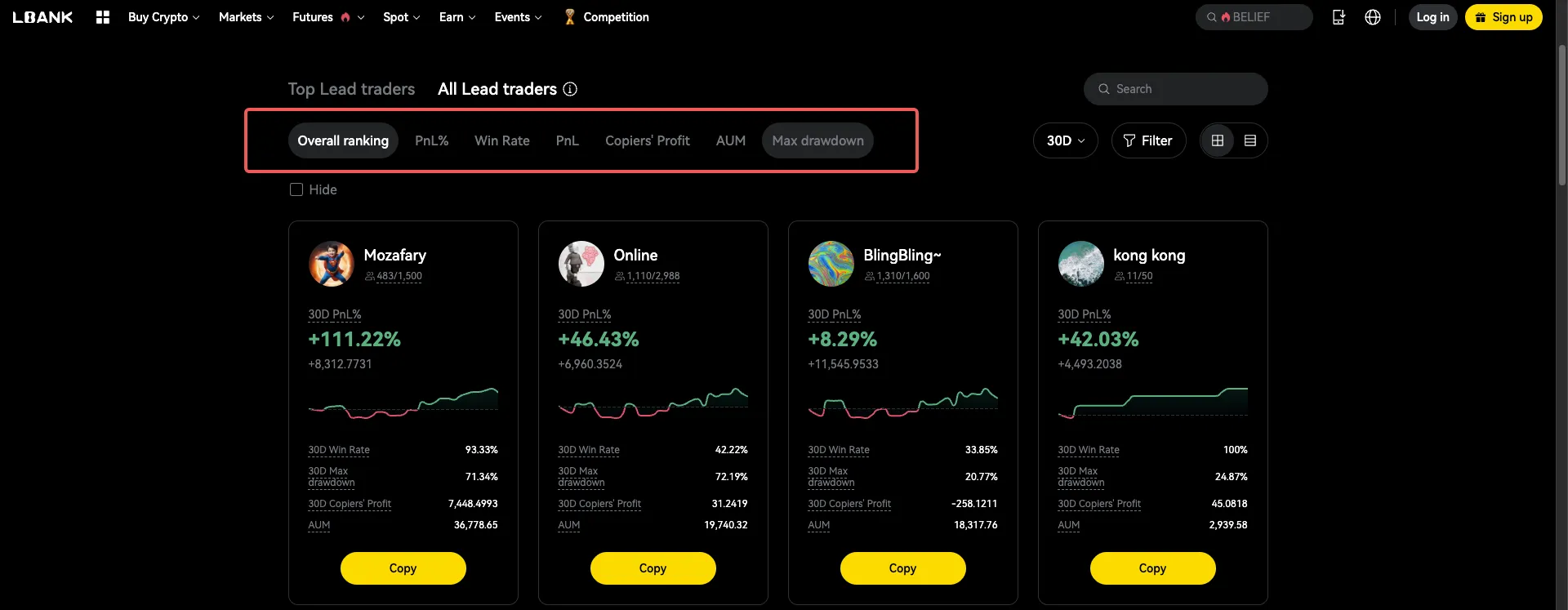
All lead traders, LBank Copy Trading
Step 5. Click "Copy" and configure
On the trader's profile, click the Copy button, then set your allocation (fixed amount or fixed ratio), your take-profit and stop-loss thresholds, and your maximum position size. Review once more before confirming.
Step 6. Monitor and adjust
Check your copy trading dashboard regularly. You can pause, resume, or stop copying at any time. If a trader's drawdown exceeds your tolerance, stop; don't wait for it to "come back."
Meet 3 Top Lead Traders on LBank
As of April 2026, three lead traders on LBank are worth studying as case studies. Stats are live at the time of writing; check current numbers before you copy.
1. Elon.Musk: The Breakout Performer
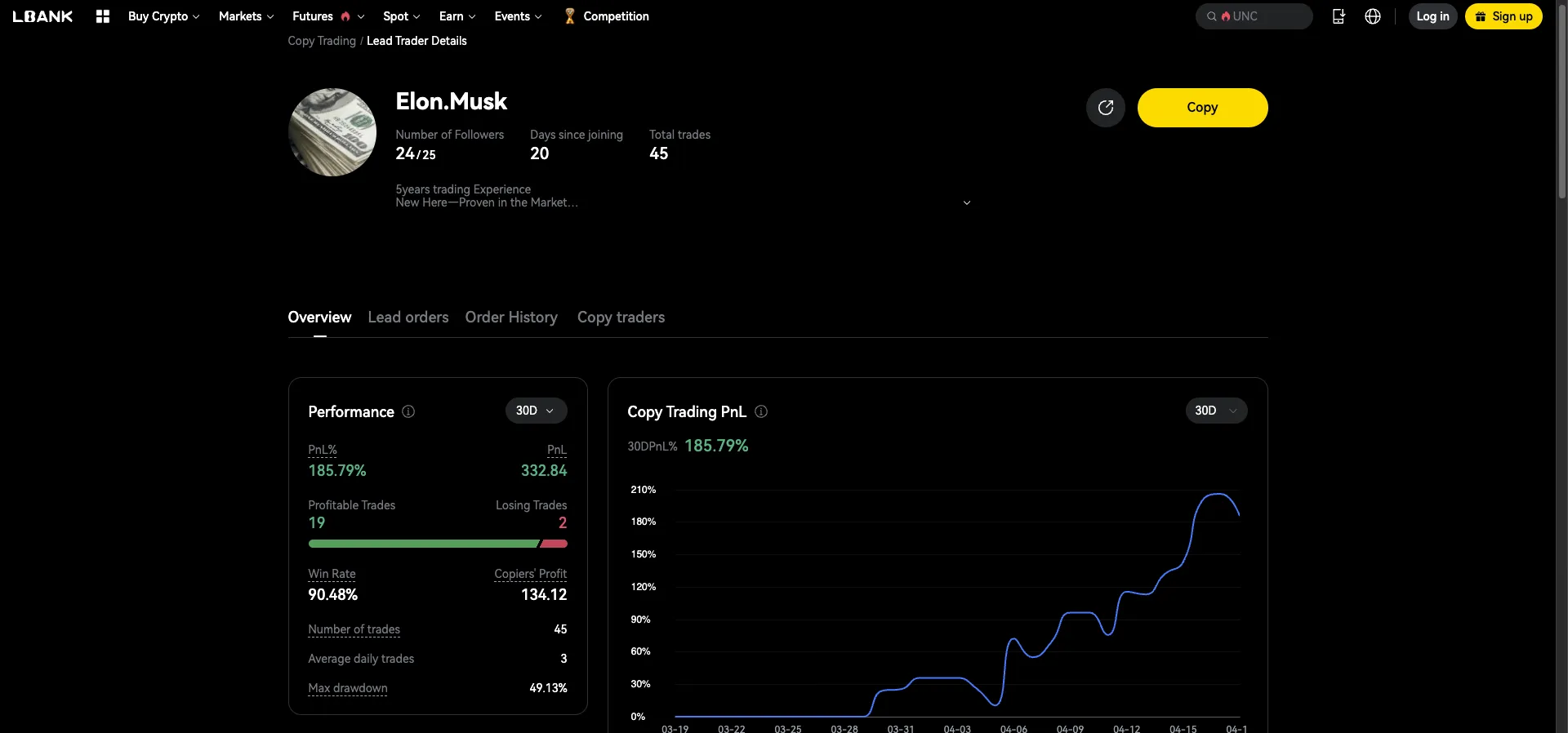
Elon.Musk lead trader profile on LBank
Elon.Musk is currently posting a 30-day ROI of +185.79% with a 90.48% win rate (19 profitable trades to 2 losers in the last 30 days). Copier slots are 24 of 25 filled, the account has been on the platform for 20 days, and has placed 45 trades. The trader describes the approach as "plan-driven, timed exits, no chasing."
The numbers are aggressive and the win rate is high, but this trader also has the highest drawdown and the shortest track record of the three profiled here. Slots are filling fast. Useful as a high-risk, high-return allocation in a diversified portfolio, but not a single-trader bet.
2. Selectum: The Disciplined Systematist
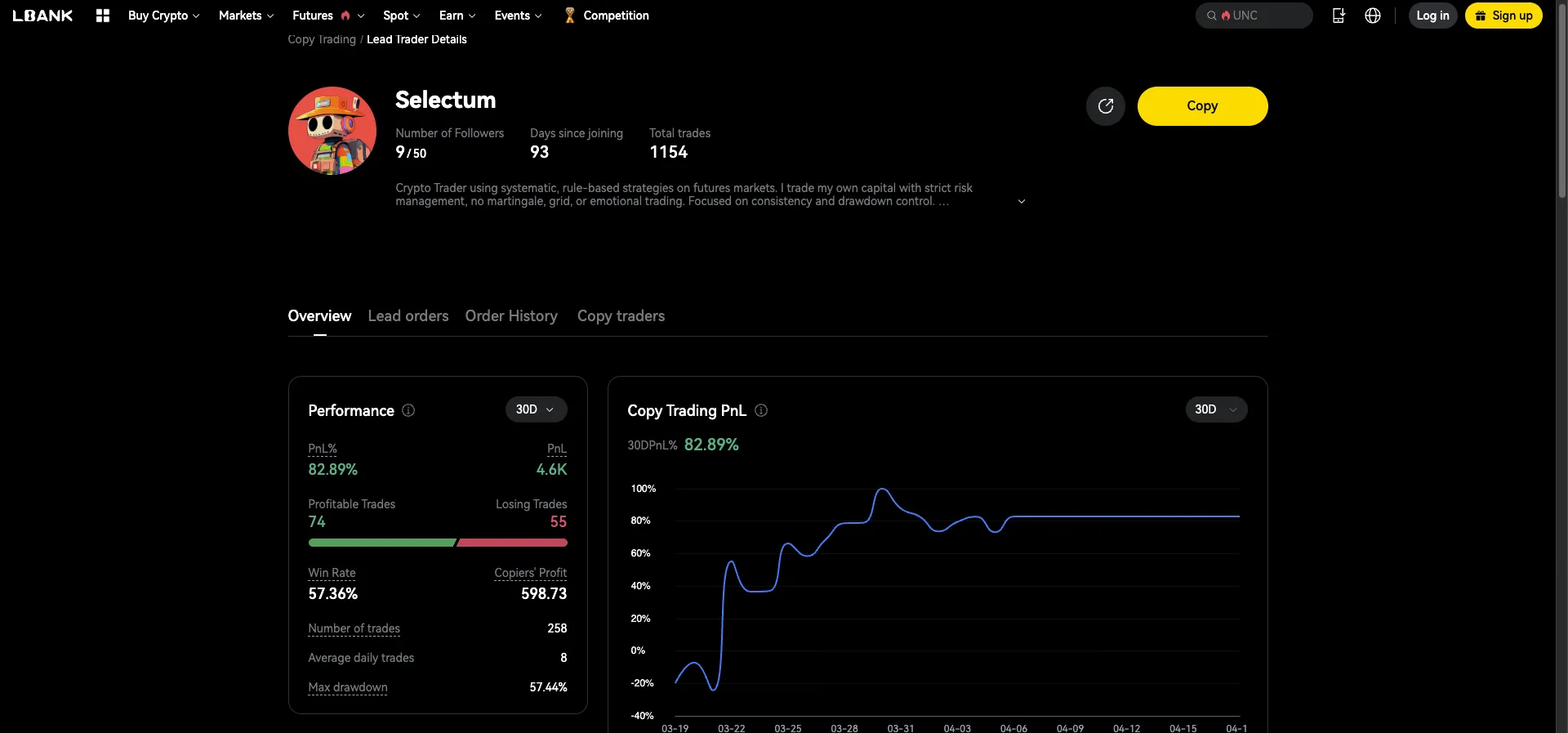
Selectum lead trader profile on LBank
Selectum posts a +82.89% 30-day ROI at a 57% win rate (74 profitable to 55 losing over the last 30 days), with 9 of 50 copier slots filled. The account has 93 days of history and 1,154 total trades, the strongest sample size of the three. Selectum describes the approach as "systematic, rule-based futures trading, with no martingale, no grid, and no emotional entries," adding in the bio: "I trade my own capital with strict risk management, focused on consistency and drawdown control."
The lower win rate is typical of rules-based systems, which take many small losses in order to catch a few larger wins. The combination of a high trade count, clean risk-management language, and a moderate ROI makes Selectum the most statistically robust profile of the three.
3. kong kong: The Balanced Veteran
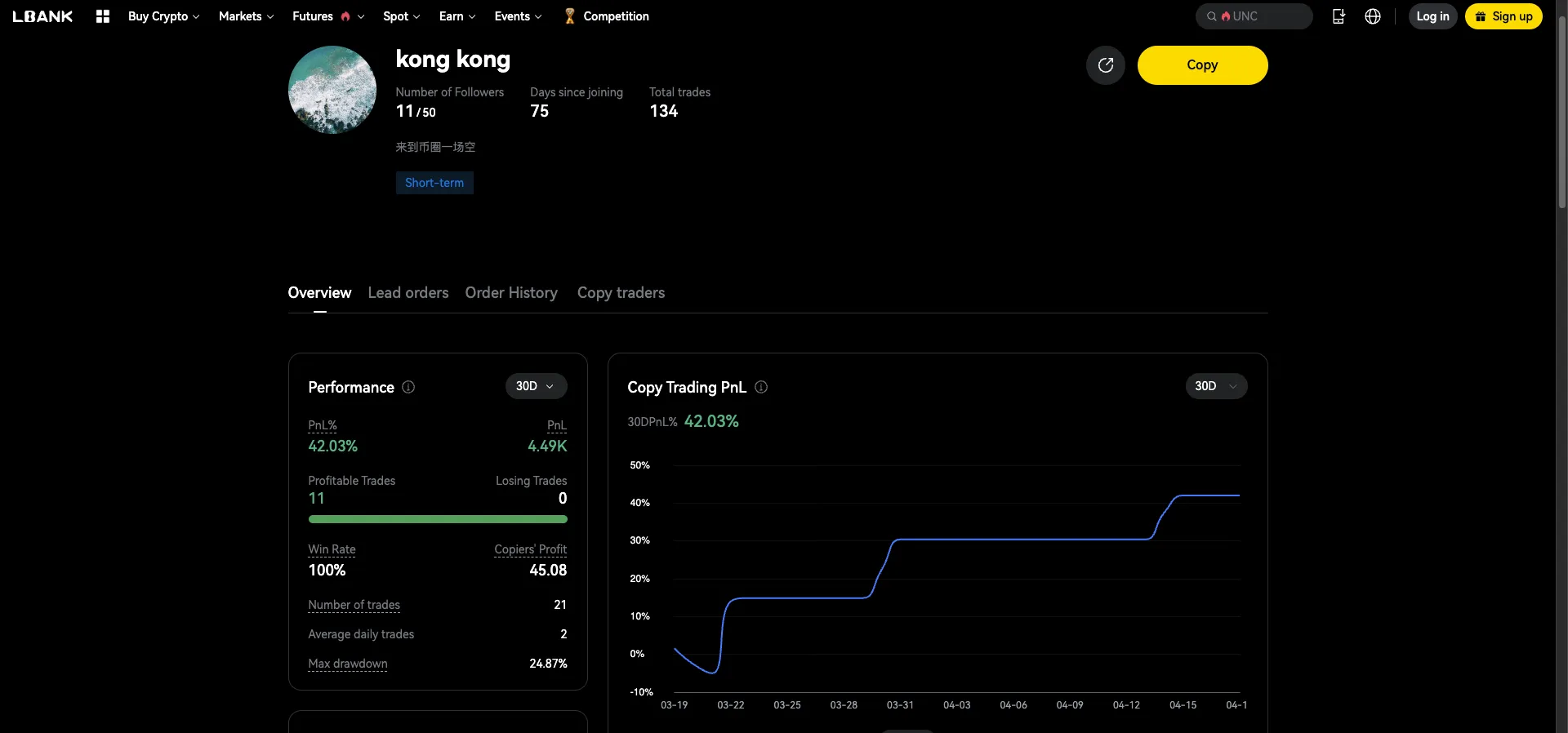
kong kong lead trader profile on LBank
kong kong sits at +42.03% 30-day ROI across 134 trades over 75 days, with 11 of 50 copier slots filled. Notably, the 30-day window shows 11 profitable trades and zero losers, a 100% win rate on a small sample that suggests a highly selective swing-style approach. Worth watching but the small 30-day sample size means the win rate could revert. A useful balance-of-portfolio option if you're already copying a higher-risk trader like Elon.Musk.
How to Become a Lead Trader on LBank
If you have a consistent strategy, becoming a lead trader can turn your trading into recurring income. As of April 2026, LBank has recorded 250,000+ copy trades and paid out 1,200,000+ USDT in profit sharing to its lead traders.
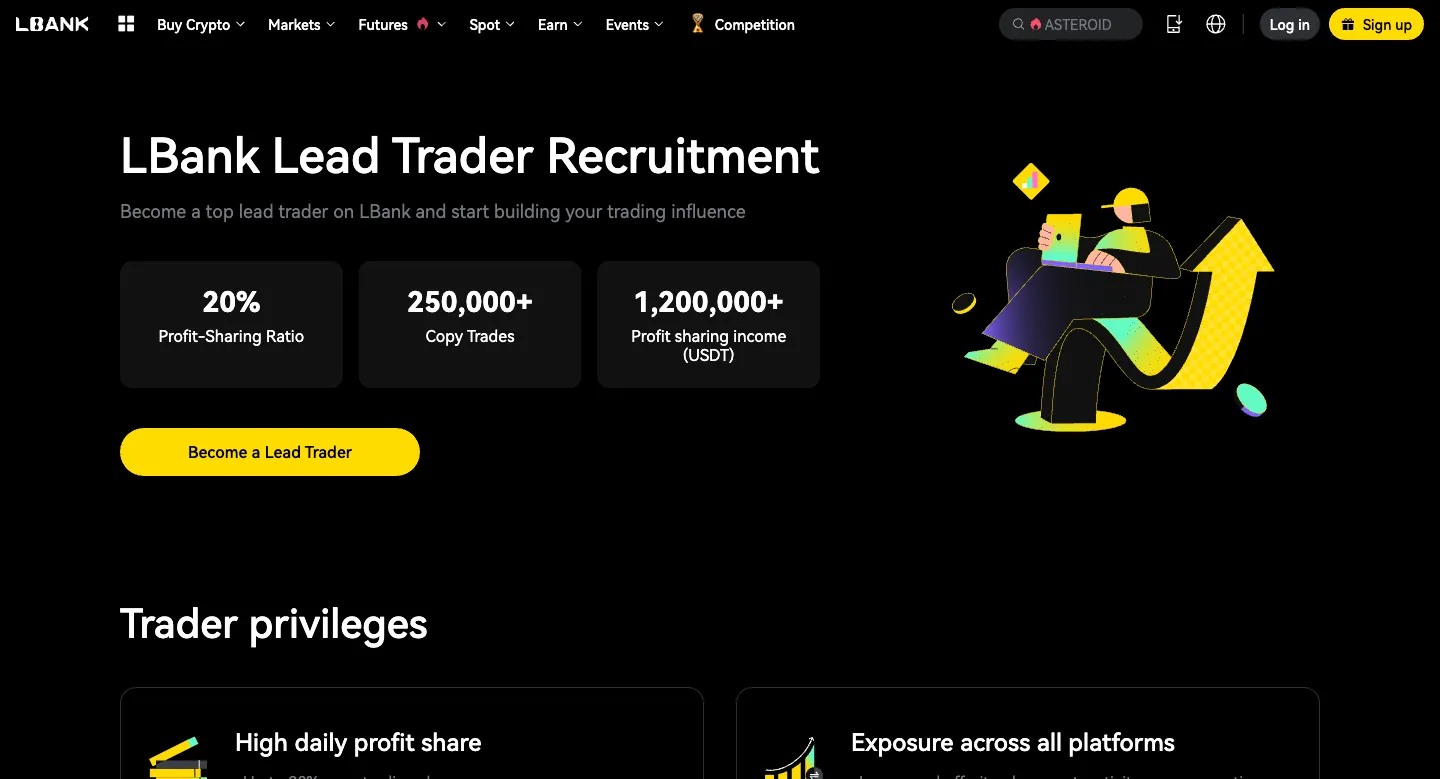
Source: LBank Copy Trading, Leader Recruit
Entry requirements are intentionally low. You need a minimum of 50 USDT in account equity to apply for the Bronze tier, and there's no mandatory ROI or follower threshold. Profit share rises from 10% at Bronze to 20% at King based on equity.
Alongside profit share, qualifying lead traders get daily profit settlement, up to 5,000 USDT in trading funds for top performers, a monthly salary subsidy, and extra trading fee cashback. LBank also provides marketing exposure across in-app placements, homepage banner, app push, Twitter, and Telegram, plus a dedicated account manager with 24/7 one-on-one support at higher tiers.
Is Copy Trading Profitable? A Realistic Look
Copy trading can be profitable, but the realistic expectation for a well-chosen portfolio of lead traders is closer to steady single- or low-double-digit monthly returns, not the headline 200%+ ROI you see on the top of any leaderboard.
Whether you profit comes down to four things.
- Trader selection is first: prioritize traders with three or more months of consistent performance over someone with a 10-day 300% spike.
- Drawdown discipline matters just as much, because a trader with a 30% max drawdown will, statistically, hit that drawdown again; only copy if you can afford to sit through it.
- Diversification is the third lever: copy three to five traders across different strategies, and never put more than 20% of your copy-trading capital into a single trader.
- Finally, time horizon. Copy trading compounds, and expecting life-changing returns in 30 days is how most copiers blow up accounts.
The traders with the best long-term copier outcomes are not always the ones with the highest headline ROI. They're the ones with the lowest drawdowns relative to their returns, a rough proxy for Sharpe ratio.
Tips for Picking the Right Lead Trader
Start with a minimum of three months of track record and ignore traders with under 90 days of history, no matter the ROI. Always check max drawdown alongside ROI, because a 100% ROI trader with a 70% drawdown is riskier than a 40% ROI trader with a 15% drawdown. Trade count matters too: 500+ trades on a track record is far more statistically meaningful than 20.
Match the trader's style to your risk tolerance, since high-leverage futures traders are a very different product from low-leverage spot swing traders. Diversify across three to five traders, because one trader is a concentrated bet, not a strategy. And re-evaluate monthly, because good lead traders can turn bad; review your portfolio every 30 days and cut underperformers early.
Closing Thoughts
Copy trading is one of the most accessible ways to get crypto market exposure without becoming a full-time trader, but it rewards discipline, not luck. Pick a diversified set of lead traders with proven track records, size positions conservatively, and treat the first three months as learning time.
Disclaimer: This content is for educational purposes only and does not constitute financial, investment, or trading advice. Cryptocurrency trading carries a high level of risk and may not be suitable for all investors. Past performance is not indicative of future results. Always do your own research and never invest more than you can afford to lose.
Copy Trading: Frequently Asked Questions
Reference materials
Read More
Meet UNC: The Solana Meme Coin Now on LBank
UNC (unc) is officially live on LBank as of April 15, 2026. The Solana-based meme token is now available to trade in the UNC/USDT spot pair, giving LBank users direct access to one of the latest community-driven tokens on the Solana blockchain.

LBank Lists SPACEX Pre-Market Futures: Launch Date and Trading Details
LBank has listed SPACEX/USDT as a pre-market delivery contract that launches on April 20, 2026 at 15:30 UTC. Get the full specs, settlement rules, and trading details.