LBank TradFi Asset Trading is an innovative derivatives product that connects traditional financial markets with the crypto ecosystem. Users can trade price movements in traditional financial assets, including U.S. equities such as AAPL and TSLA, as well as gold, crude oil, forex, and global indices, using USDT or other supported crypto assets as margin, without purchasing or holding the underlying assets directly.
By integrating TradFi exposure into the futures environment, LBank enables users to access multiple asset classes within a unified trading account. Compared with conventional market access, TradFi Asset Trading offers greater capital flexibility and operational efficiency. Trading hours, market closures, and product-specific rules are subject to the trading interface and official announcements.
Funding Fee Mechanism
Funding fee rules vary by product. Stock equity-related Futures are currently exempt from funding fees, while certain commodity-related products and other instruments may incur funding fees. Please refer to the trading page for the latest applicable rules.
How is Profit and Loss (PnL) Calculated?
PnL Calculation:
Example:
When Does Liquidation Occur?
LBank employs industry-standard perpetual contract risk controls:
-
The system monitors the position margin ratio in real time, calculated based on the fair price.
-
When the margin ratio falls to the predefined liquidation threshold, forced liquidation is automatically triggered to limit potential losses.
How to Participate?
Register an LBank Account
-
If you do not have an account, register via:
Fund Your Account
-
Transfer USDT or other supported cryptocurrencies from your spot wallet to your futures wallet.
-
For detailed steps and security information, please refer to「LBank Deposit Guide」.
Access TradFi Assets
-
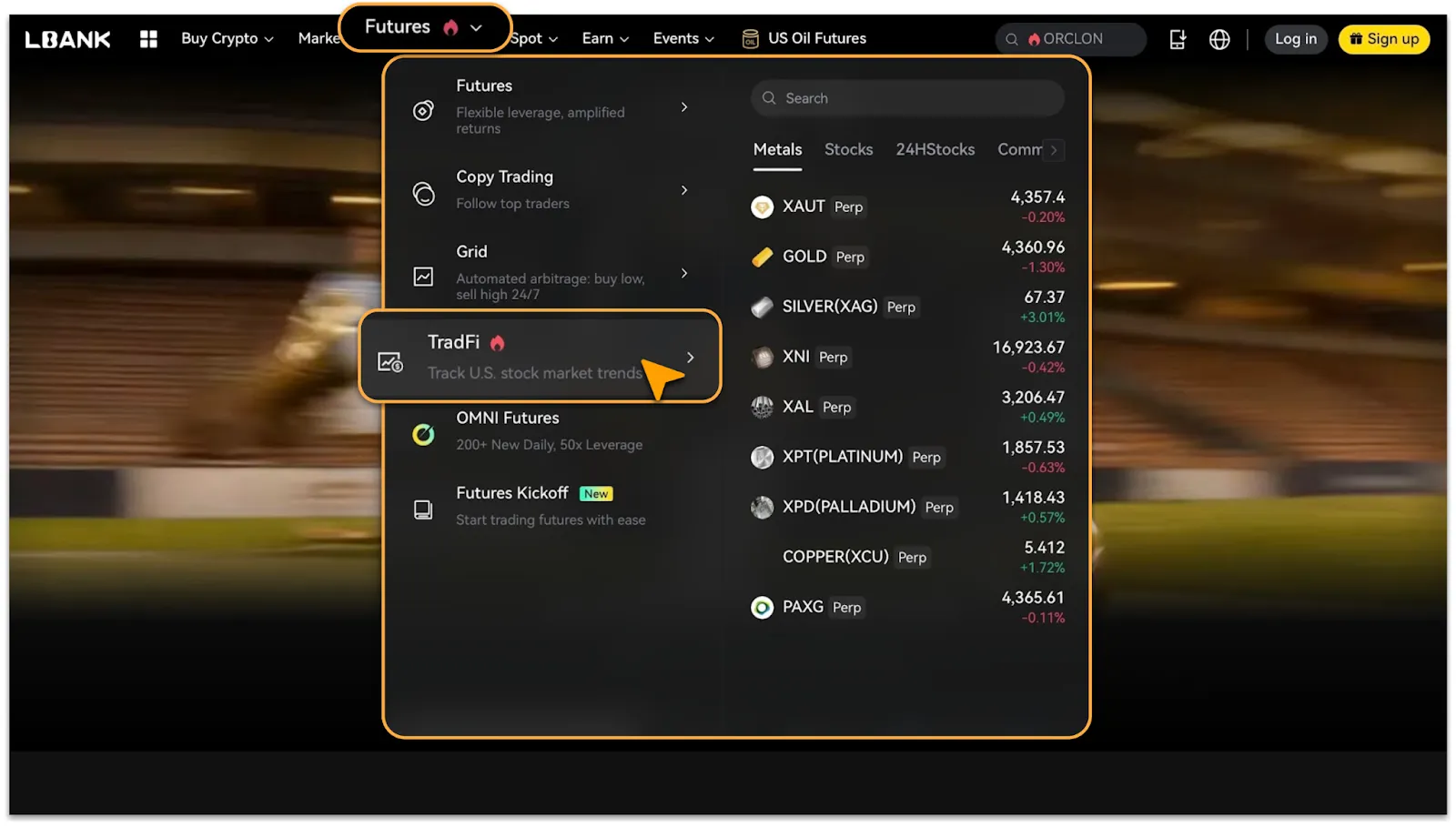
Log in and navigate to「Futures > TradFi」.
-
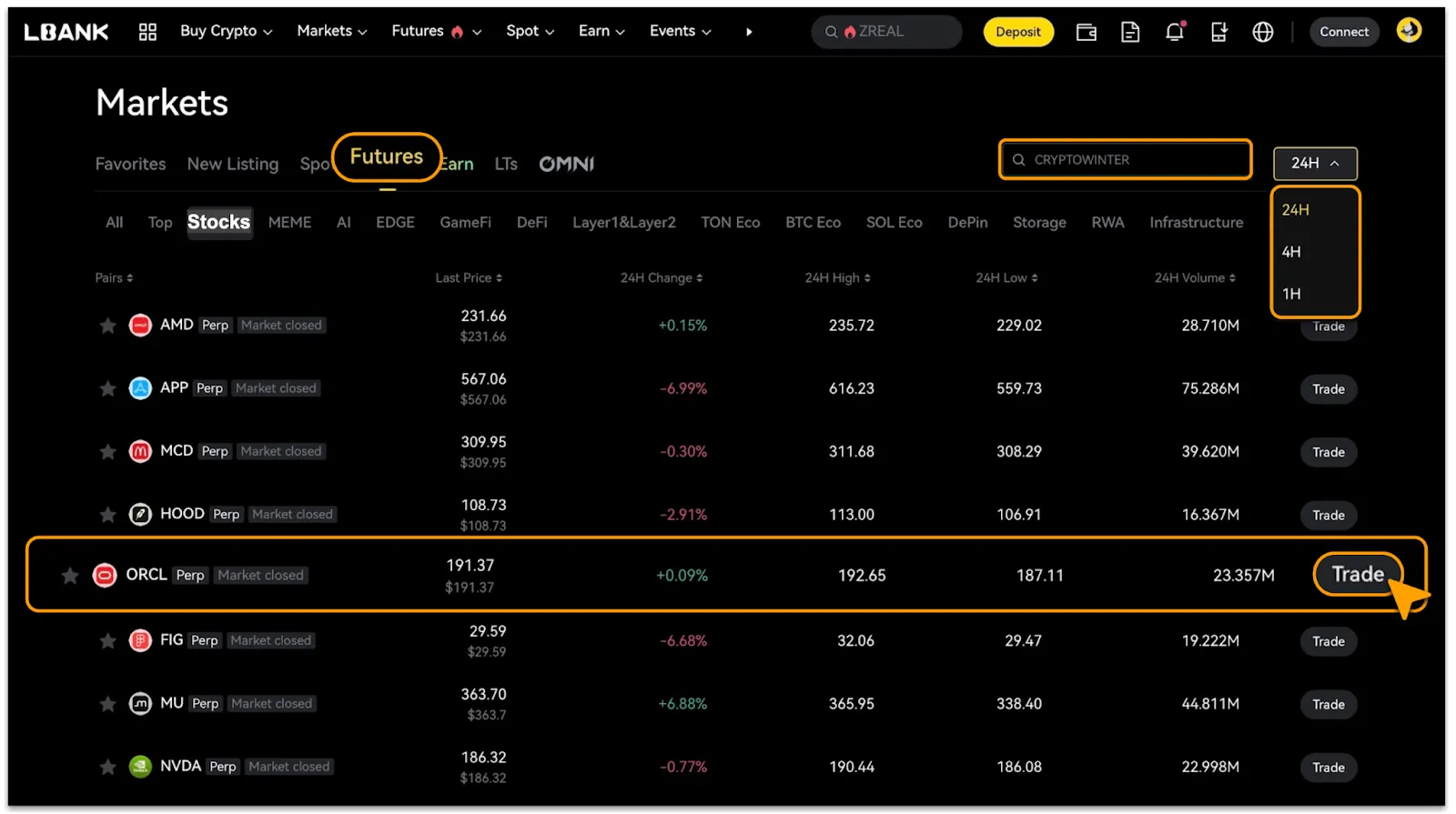
Browse available pairs (e.g., AAPL-USDT, TSLA-USDT), including「Latest Price」,「24h Change」,「24h High/Low」, and「24h Volume」.
-
Click Trade on your selected pair to enter the trading interface.
-
Note: If a pair is marked as「Market Closed」, you may cancel pending orders or add margin, but new orders or closing positions are not permitted.
Trading Operations
-
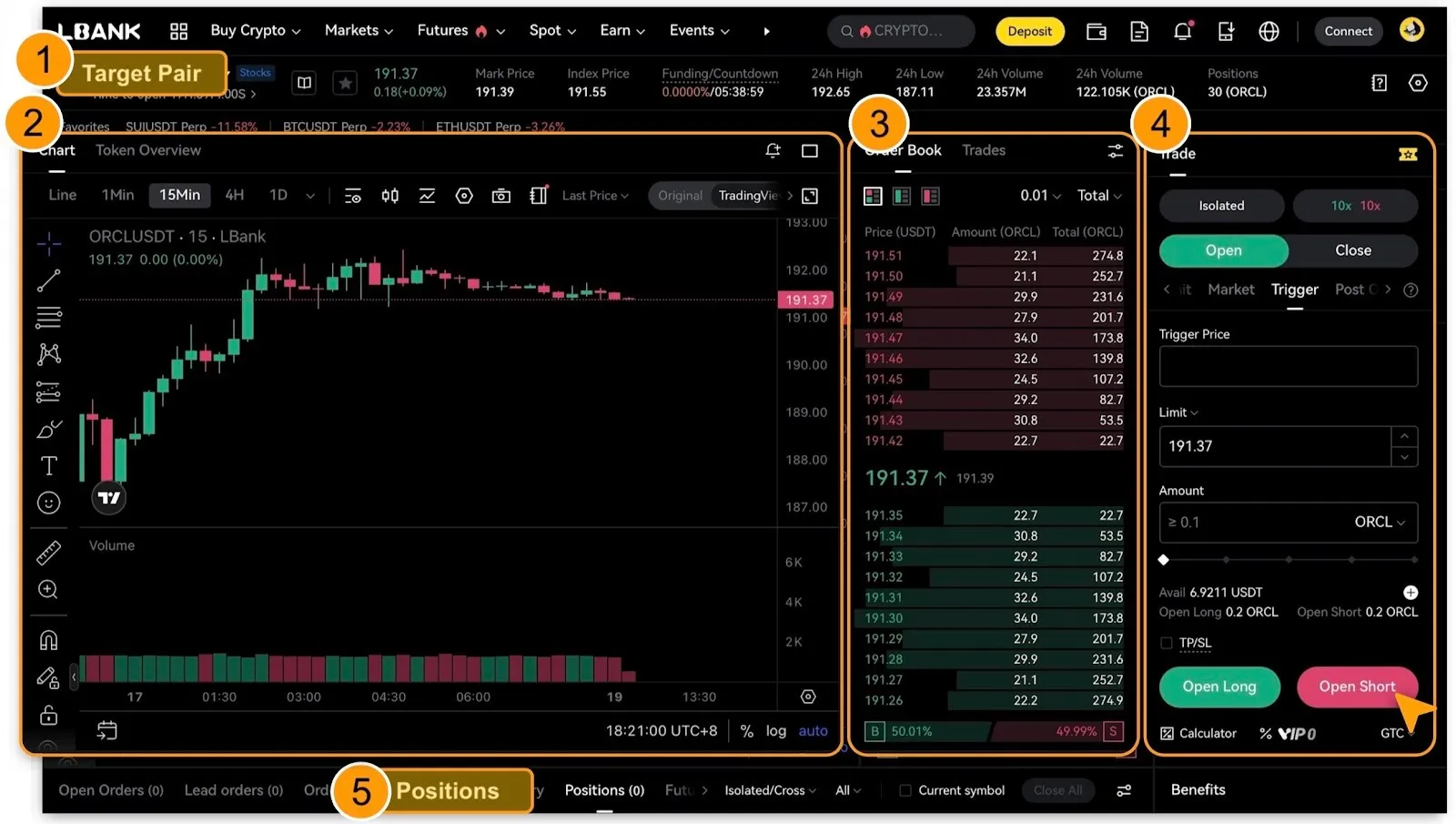
Confirm Trading Pair: Use the search bar if needed.
-
View Charts: Analyze multi-dimensional data for the pair.
-
Order Book: The matching engine follows “price-time priority” to ensure fair and continuous trading.
-
Set Trading Parameters:
-
Margin Mode: TradFi Futures currently default to Isolated Margin mode, with Cross Margin mode available for selected assets. As risk management and capital utilization vary by margin mode, users are advised to refer to the trading interface for the actual availability of each mode by asset.
-
Direction: Long (bullish) or Short (bearish).
-
Leverage & Quantity: Up to 500x leverage available. Leverage amplifies both gains and losses—choose based on your risk tolerance. Enter quantity (multiplier typically 1 = 1 share).
-
Order Types:Market, Limit, Planned (trigger), and Post Only orders, consistent with standard perpetual contracts. Submit after confirming sufficient margin.
-
Monitor Positions: Track margin ratio, fair price, and other metrics in real time.
-
Closing Positions: Manually close when target reached, or set take-profit/stop-loss.
-
Note: No new orders or closures during market close periods.
Frequently Asked Questions
-
How is the fair price of TradFi assets calculated?
-
The fair price is calculated by aggregating market prices from multiple major sources based on the underlying asset. For stock-related assets, the latest price of the underlying stock is an important reference.
-
What margin modes are supported for TradFi assets?
-
TradFi asset contracts use Isolated Margin by default. Some assets also support Cross Margin. Isolated Margin helps manage risk for each position separately, while Cross Margin can improve capital efficiency. Please refer to the trading page for the margin mode available for each asset.
-
Can I trade TradFi Assets during market close periods?
-
During market closure, you can cancel unfilled orders or add margin, but you cannot place new orders or close positions. To reduce the impact of price fluctuations, we recommend closing positions before the market closes. Please pay attention to market hours, holidays, and the rules of the relevant market.
-
Stock-related Equities: Trading hours follow NYSE/Nasdaq market sessions and are adjusted for U.S. daylight saving time. For details, please refer to「TradFi Assets <> U.S. Stock Trading Schedule 2026」for details.
-
Commodities (including Metals): Trading hours follow the schedule of the relevant commodity market. Please refer to the Futures details page.
-
Other TradFi Assets: Trading hours are subject to the rules of the relevant market and platform announcements.
-
Does it support leverage?
-
Yes, up to 500x. Higher leverage increases both potential returns and liquidation risk—use cautiously.
-
How are stock splits, reverse splits, dividends, and similar events handled?
-
In cases of stock splits, reverse splits, dividends, or similar events, the platform may implement early settlement to close positions uniformly. Trading resumes afterward. Monitor official announcements.
-
How do TradFi Assets differ from regular crypto perpetual contracts?
-
Trading mechanics, order types, and liquidation rules are identical. If you are familiar with BTC or ETH perpetuals, TradFi Assets are easy to adopt. For stock-related assets, the latest price of the underlying stock is an important reference.
-
Can bonuses be used for TradFi Assets?
-
Bonus Pro: Fully supported.
-
Standard Bonus: Usable for margin, fee offsets, or loss coverage (per campaign rules). Own funds are deducted first; bonuses are used only after own funds are exhausted. To prioritize bonus usage, manually transfer/add it as margin. Bonuses are futures-only and non-withdrawable.
-
Position vouchers are not supported for this product currently.
Important Notes
-
Leverage Risk: Leverage magnifies both profits and losses, increasing liquidation risk. Beginners should start with low leverage.
-
Trading Hours:
-
TradFi Asset trading hours depend on the schedule of the underlying market. For stock equity-related assets, trading hours generally follow NYSE and Nasdaq sessions and are automatically adjusted for U.S. standard time and daylight saving time. Using UTC+8 as an example:
-
Winter Time (standard): Monday 12:00 – Saturday 08:30 (UTC+8).
-
Summer Time (DST): Monday 12:00 – Saturday 07:30 (UTC+8).
-
DST starts: Second Sunday in March (e.g., March 8, 2026).
-
Standard time starts: First Sunday in November (e.g., November 2, 2025).
-
During weekends/closures (Saturday after 08:30/07:30 until Monday 12:00), only order cancellation and margin addition are allowed.
-
Close positions before closure to mitigate gap risk. Check official announcements for holidays.
-
Corporate Actions: Early settlement may apply for splits, mergers, dividends, etc. Follow platform notices.
-
Account Security: Enable Google Authenticator(2FA) for account protection.
Reminder
LBank TradFi Assets trading follows the same interface and logic as BTC/ETH perpetual contracts—seamless transition for experienced users. Fair price derived from multiple trusted sources ensures reliability. For further questions, contact LBank Customer Support.
LBank is committed to delivering a secure and stable trading experience.Trading involves risks. Invest responsibly. Happy trading!
