

The Founder: Sam Thapaliya
Zebec's story is impossible to separate from the personal story of its founder. Sam Thapaliya was born in 1998 in Bharatpur, Chitwan, a rural area of Nepal. He grew up in a household that had no access to banking until he was thirteen years old. That formative experience of financial exclusion shaped the vision he would eventually build Zebec around.
Thapaliya developed a passion for programming in his early teens, building ERP software systems for local businesses before most of his peers had any exposure to software development. In 2017, after completing high school, he moved to California with, by his own account, $100 to his name. He enrolled at Menlo College in the San Francisco Bay Area, graduating with a degree in Computer Science and Information Management.
During college in 2018, he co-founded ASMI, Augmented and Segmented Media Interface Corporation, a B2B SaaS company using computer vision and behavioral analytics for video advertising technology. ASMI's work led to four US patents in AI and video analytics, demonstrating his technical depth well before he entered the blockchain space. In a Circle Founder Q&A, Thapaliya reflected on the journey: "I was born in the middle of nowhere in Nepal. I never saw a bank until I was 13 years old, and now I am helping to create a new generation of financial services products for the masses."
That context is directly relevant to why Zebec exists as it does. The problem Thapaliya set out to solve was not abstract DeFi optimization. It was practical financial access. Streaming payroll that settles every second gives a gig worker in an underbanked region immediate access to earned wages rather than waiting for a bank transfer cycle to complete. The same technology that benefits a Web3 developer at a crypto-native company also serves agricultural workers, freelancers, and contracted employees who have historically had the least flexibility over when they receive payment.
Thapaliya launched Zebec on Solana in 2021, built Nautilus Chain as its own Layer 3 EVM infrastructure, and has since expanded the protocol into a full-stack financial network spanning payroll, cards, treasury management, and DePIN infrastructure. He has also become a founding advisor and investor in projects including Eclipse and Cedro Finance, contributing to the broader Solana and modular blockchain ecosystem.
Siman Babakhani, CEO has been Zebec's primary public face on the business and institutional development side. Babakhani has represented Zebec in high-profile partnership discussions, including conversations with institutional players in the payments space, and leads the day-to-day operational execution of Zebec's enterprise strategy.
Price of Zebec ($ZBCN) on LBank
ZBCN() कीमत
How the Streaming Payment System Actually Works
This is the section that requires careful explanation because the concept is straightforward but the implementation involves multiple technical layers operating together.
At the protocol level, Zebec uses smart contracts to create payment streams. A stream is a financial primitive that moves value from one party to another at a defined rate per unit of time. Rather than a single large transaction, a stream is an open channel between a sender and recipient that continuously transfers value until the stream is paused, cancelled, or completed.
Here is how a real payroll scenario works step by step.
An employer first deposits funds into a Zebec smart contract on their chosen blockchain, which can be Solana, BNB Chain, Ethereum, Base, or the Nautilus Chain. This deposit serves as the reservoir from which the stream will draw. The employer then configures a stream to an employee's wallet address, specifying the rate at which funds should transfer. For a $52,000 annual salary, that rate is approximately $0.001648 per second. The smart contract executes this transfer continuously without requiring any further action from the employer.
The employee's wallet balance increases in real time. They can check their balance at any moment and see earnings accumulating. They can withdraw at any time without waiting for a payroll cycle. The employer's deposited funds deplete at the specified rate until the stream is paused or the deposit runs out. If the employer needs to adjust the amount, delay payment, or cancel the arrangement, they interact with the smart contract directly. Everything is on-chain and transparent.
The Zebec middleware layer sits above this smart contract logic and handles the user-facing complexity. This abstraction layer translates the on-chain mechanics into a familiar payroll dashboard experience, so employers using Zebec do not need to understand smart contracts to configure streaming payroll for their teams. They see an interface that looks like standard payroll software, with the blockchain infrastructure operating invisibly underneath.
Cross-chain compatibility adds another dimension. Zebec's streaming protocol is not confined to a single network. Through bridge infrastructure and the Nautilus Chain, payment streams can be routed across blockchains, allowing an employer on Solana to send streaming payments to a recipient who prefers to receive on Ethereum or BNB Chain. The Nautilus Chain, Zebec's own EVM-compatible Layer 3 blockchain built on Eclipse infrastructure, provides high-speed, low-cost execution specifically optimized for continuous payment processing without the congestion risks of mainnet Ethereum.
The traditional banking integration layer is the most recent and most significant addition to this stack. Through the NatPay partnership announced in December 2025, Zebec can route payouts through both traditional bank rails including ACH, wire, and FedNow, and the Web3 streaming rails simultaneously, from a single platform. NatPay processes over $170 billion annually for more than 300,000 ACH clients. This integration means an employer can pay some employees via direct deposit to traditional bank accounts and others via streaming crypto wallets, all managed within the same Zebec interface. ISO 20022 compliance, also achieved in December 2025, is the global financial messaging standard used by SWIFT, central banks, and major payment networks, and represents the technical prerequisite for participation in institutional financial infrastructure at this scale.
Real World Applications Zebec Is Building
The streaming payment protocol is the foundation, but Zebec has built a portfolio of real-world products on top of it that connect that infrastructure directly to everyday financial life.
Zebec Payroll is the flagship enterprise product. Employers configure streaming salary payments, contractor disbursements, and DAO treasury payouts through the Zebec payroll interface. The system supports over 150 tokens across multiple chains and handles cross-border payments without the three-to-five business day delays and correspondent banking fees typical of international wire transfers. Zebec processes over $500 million in annual payroll volume for its enterprise client base, which now includes companies across both Web3 and traditional sectors.
Zebec Card is the consumer-facing product that closes the loop between on-chain value and real-world spending. Available in both Zebec Silver and Zebec Black tiers, the card is a Mastercard-powered crypto debit card available in 138 countries. Users fund their card with ZBCN or any of 150 supported tokens. At the point of sale, the crypto balance is converted to fiat instantly and settled with the merchant in the local currency. For an employee receiving a streaming paycheck in USDC, the Zebec Card converts that directly to spendable fiat without requiring a separate exchange or bank account step. The card supports real-world spending at any merchant that accepts Mastercard globally. A partnership with Canton Network announced in February 2026 introduced the first Mastercard debit card native to the institutional Canton Network, extending the card's reach into institutional-grade financial infrastructure.
Zebec Pay SuperApp is the consolidated mobile and web interface launching in Q1 to Q2 2026 that merges payroll streaming, card management, staking, treasury tools, and cross-chain payments into a single application. The SuperApp is designed to function as the primary financial operating layer for both individual users and enterprise clients, with ZBCN integration throughout for fee reduction, rewards access, and governance participation.
ZePIN and DePIN Point of Sale is Zebec's decentralized physical infrastructure play. The team has developed proprietary Point of Sale terminals and systems that allow merchants to accept crypto payments directly at the hardware level. This extends the Zebec ecosystem from software-only into physical retail environments, bridging on-chain payment rails with brick-and-mortar commerce. The DePIN PoS expansion is a key part of the 2026 roadmap.
ZebecNET eSIM is a partnership with World Mobile Team to launch a data-only eSIM network optimized specifically for real-time financial transactions. The practical problem this addresses is that streaming payments and real-time financial infrastructure require reliable connectivity. Users in regions with inconsistent internet access cannot benefit from second-by-second payroll streaming if their connection drops. ZebecNET provides always-on global connectivity specifically designed around the needs of Zebec's payment ecosystem.
Stellar Payroll Deployment launched in March 2026 marks Zebec's first major deployment outside its original Solana ecosystem. Selected by the Stellar Development Foundation to build native real-time USDC payroll infrastructure on Stellar's network, Zebec now enables workers in underbanked regions to receive continuous earnings into digital wallets with instant cash conversion through MoneyGram's network of over 450,000 locations globally. This deployment directly addresses the financial inclusion mission at the core of Thapaliya's founding vision.
Zebec Network: Key Milestones From 2021 to Today
Zebec founded on Solana — streaming payroll launches
Sam Thapaliya launches Zebec Protocol on Solana with ZBC as the native token. The core concept is continuous settlement: employees receive salary per second via smart contract streams rather than waiting for batch payroll cycles. Initial seed funding closes with Circle, Coinbase, and Solana Ventures participating.
$35M raised across seed, Series A, and public rounds
Zebec completes a full funding cycle raising $35 million in total from Coinbase Ventures, Circle Ventures, Solana Ventures, Breyer Capital, Republic Capital, and Lightspeed Venture Partners. The capital validates the streaming payroll thesis with top-tier institutional backing.
Visa Fintech Fast Track partnership
Zebec joins Visa's Fintech Fast Track program, establishing early access to Visa's payment rails infrastructure. This partnership provides foundational groundwork for the eventual launch of Zebec's crypto-to-fiat card products for real-world spending.
Nautilus Chain launches — Layer 3 EVM for payments
Zebec launches Nautilus Chain, its own EVM-compatible Layer 3 blockchain built on Eclipse infrastructure. Designed for high-speed, low-cost payment streaming, Nautilus reaches approximately 2 million transactions and 340,000 registered wallets within its first four months of mainnet operation.
ZBC migrates to ZBCN — 1:10 token split
Zebec executes a token migration from ZBC to ZBCN at a 1:10 ratio between April and May 2024. Total supply expands from 10 billion to 100 billion with no change in holder value. The migration simplifies gas fee calculations, improves token accessibility, and reflects the network's multi-chain expansion.
Zebec Card launches — Mastercard crypto debit card
The Zebec Card program goes live in Silver and Black tiers, powered by Mastercard and available in 138 countries. Users fund the card with ZBCN or 150 supported tokens, which convert instantly to fiat at the point of sale. The card directly links on-chain streaming payroll to real-world merchant spending.
Nacha Alliance membership and ISO 20022 compliance
Zebec joins the Nacha Payments Innovation Alliance in December 2025, connecting to the $85 trillion US ACH network alongside JP Morgan, Wells Fargo, Circle, and ADP. Simultaneously achieves ISO 20022 compliance, the global financial messaging standard required for institutional adoption at scale.
NatPay partnership — FedNow and ACH integration
Zebec announces a partnership with NatPay, which processes over $170 billion annually for 300,000+ ACH clients. Employers can now route payouts through traditional bank rails including ACH, wire, and FedNow alongside Zebec's streaming crypto infrastructure from a single unified platform.
Stellar payroll deployment — underbanked regions
The Stellar Development Foundation selects Zebec to build native real-time USDC payroll infrastructure on Stellar. Workers in underbanked regions receive continuous earnings into digital wallets with instant cash conversion via MoneyGram's 450,000 global locations. Zebec's first major deployment outside Solana.
Final token unlock — fully deflationary model activates
ZBCN's final vesting schedule completes in March 2026. No new tokens enter circulation from any allocation category. Supply dynamics shift entirely to contraction through fee burns and revenue-funded buybacks. Buyback volume has grown at 70%+ annualized since the program launched.
Institutional Integration: Nacha, NatPay, and the ACH Network
The December 2025 Nacha Payments Innovation Alliance membership deserves specific attention because it represents a qualitative shift in what Zebec is positioned to do.
Nacha governs the Automated Clearing House network, the backbone of US bank payments. In 2024, the ACH network processed over $85 trillion in transactions. Every US direct deposit, bill payment, and bank-to-bank transfer runs through this infrastructure. Nacha membership requires adherence to strict payment processing standards, meaning Zebec's technology has been vetted against the compliance requirements of traditional banking.
Being in that alliance alongside JP Morgan, Wells Fargo, Fiserv, Circle, and ADP is not simply a branding milestone. It establishes Zebec as a recognized participant in US payment infrastructure conversations, opens access to pilot programs and integration pathways that are not available to non-members, and signals that the compliance infrastructure Zebec has built meets the standards required to operate alongside regulated financial institutions.
The NatPay integration is the practical implementation. NatPay is a payroll and payments technology company that processes over $170 billion annually across more than 300,000 ACH clients. Through this partnership, employers using Zebec can access FedNow, traditional ACH rails, and Zebec's blockchain streaming layer from a single dashboard. That hybrid capability is the key differentiator: Zebec is not asking employers to abandon bank rails entirely and move to crypto-only systems. It is offering a bridge that lets both exist simultaneously, removing the adoption friction that has slowed most blockchain payment projects.
Image by Zebec Network
ZBCN Tokenomics: Supply, Utility, and the Deflationary Shift
ZBCN is the governance and utility token of the Zebec Network. Understanding its current state requires knowing the full history of how it arrived here.
The original token was ZBC, launched on Solana in 2021. In April and May 2024, Zebec executed a token migration from ZBC to ZBCN at a 1:10 ratio. Every ZBC holder received 10 ZBCN per ZBC held. The old ZBC tokens were burned. The total supply expanded from 10 billion ZBC to 100 billion ZBCN, but no holder's economic value changed. The primary reasons for the migration were to simplify gas fee calculations by using whole numbers per transaction, improve accessibility by lowering the unit price, and better reflect Zebec's expansion from a single protocol into a multi-chain network.
The total supply of ZBCN is capped at 100 billion tokens. Token allocations follow a vesting schedule spanning multiple categories including Community and Rewards, Contributors, Private Round, Seed Round, Public Sale, and Market Making. The final scheduled token unlock is March 2026, which marks the end of all planned vesting and the point at which no new ZBCN tokens enter circulation from any allocation category.
That March 2026 milestone is the most important structural event in ZBCN's tokenomics. After it, the supply dynamics shift entirely. Supply can only contract, not expand. The mechanisms that drive that contraction are two: the fee burn, where 1 ZBCN per transaction is permanently burned, reducing total supply with every network interaction, and the buyback program, where revenue from payroll processing fees, Zebec Card transaction fees, and partner contracts is used to purchase ZBCN from the open market and remove it from circulation. The buyback program has grown at an annualized rate of over 70% since launching in late 2023, with continued growth expected as the Zebec Card and SuperApp scale globally.
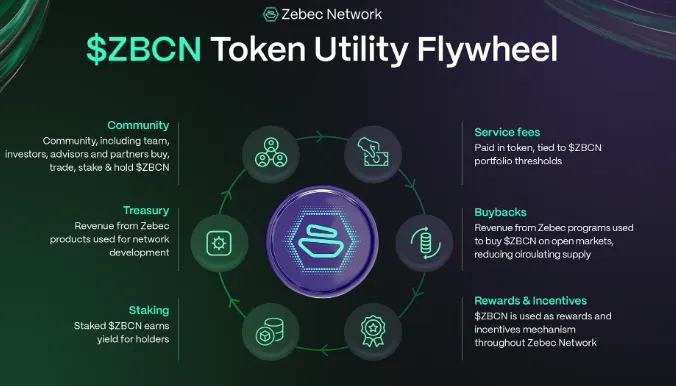
Image by Zebec.io
ZBCN's utility spans several touchpoints across the ecosystem. Employers using Zebec's payroll platform pay service and product fees in ZBCN, creating ongoing usage-driven demand directly tied to payroll volume and enterprise adoption. SuperApp users who hold and stake ZBCN unlock preferential pricing and reduced fees across products. Stakers earn yield and deepen governance participation, with staking APY available across flexible and locked durations of 30, 60, and 90 or more days. Starting mid-2026, ZBCN balances and staking levels within the SuperApp will unlock tiered rewards on Zebec Card spend, creating a direct incentive loop between token participation and everyday financial activity. ZBCN can also be used to fund Zebec Cards directly, enabling real-world spending in fiat at merchants globally alongside the 150 supported tokens.
Governance follows a hybrid DAO model. Proposals, called Zebec Improvement Proposals or ZIPs, are developed through off-chain community consultation and then put to an on-chain vote. A quorum of 33% of circulating supply is required for a vote to pass. This hybrid structure balances the transparency of on-chain decision-making with the deliberation and analysis that off-chain consultation provides, preventing governance from being captured by rapid token-voting without adequate community review.
Zebec Streaming Payroll vs Traditional Payroll:

An Honest Assessment of Where Zebec Stands
Zebec has built something that genuinely differentiates it from most blockchain payment projects: a vertically integrated financial infrastructure stack that includes its own blockchain, consumer-facing card products, enterprise payroll software, and now institutional compliance infrastructure through Nacha membership and ISO 20022 certification.
The honest risk picture is equally clear. The SuperApp rollout is the central execution challenge. Merging payroll, cards, staking, treasury management, and cross-chain payments into a single consumer-grade mobile interface is technically complex, and delays or poor user experience could undermine the product flywheel that links ZBCN usage to buyback revenue to token value. The March 2026 final unlock removes a structural overhang, but it does not automatically create buy pressure. That depends entirely on whether product adoption accelerates in the post-unlock environment.
The competitive landscape includes Superfluid and Sablier on the payment streaming side, and Ripple and Alchemy Pay on the cross-border payments side. Zebec's differentiation is not in any single feature. It is in the combination of its own chain, its consumer products, its enterprise payroll focus, and its TradFi integration. No competitor currently combines all four of those elements.
What gives Zebec its most durable foundation is the founder's clarity of purpose. The problem Sam Thapaliya set out to solve in 2021 — making money continuous, giving workers real-time access to earned wages, eliminating the batch payment inefficiency that has persisted for decades — is the same problem the platform is solving in 2026 with considerably more infrastructure, institutional validation, and global reach than it had when it started.